If you eat well but still feel bloated, tired and puffy, the problem probably isn't your food. Here's what's actually going on.
You eat well. Better than most people around you, probably.
You cook from scratch most days. You've cut the processed food, you watch your sugar, you eat your vegetables. You've done elimination diets, food diaries, maybe even tested for intolerances. You know what gluten is. You know what ultra-processed means. You are not the person who doesn't care.
And yet every morning you wake up with a belly that feels tight before you've eaten a single thing. You finish a meal you know was healthy and feel heavy, slow, uncomfortable. By mid-afternoon your energy has dropped off a cliff. The bloating comes and goes without any pattern you can identify. The puffiness around your face and midsection doesn't shift, no matter how clean you eat or how many weeks you stay consistent.
So you ask the question that brings most of my clients to me eventually:
Why am I still bloated if I eat so well?
The honest answer might surprise you because it has nothing to do with finding another food to eliminate.
The problem isn't your food, it's your load.
Here's the framework I use in clinical practice and it changes everything once you understand it.
Your body has an inflammation threshold. Think of it as a bucket. Below the line, your system manages well: digestion runs smoothly, energy is stable, bloating is minimal. Above the line though, the immune system generates a low-grade, chronic inflammatory response. That's when the symptoms start: bloating, fatigue, puffiness, brain fog, cravings that hit at the same time every day, belly weight that won't shift, sleep that doesn't restore.
The critical thing to understand is this: many things fill that bucket, not just food.
Food is one input, but the bucket also fills from poor sleep, chronic stress, blood sugar instability, cortisol dysregulation, environmental chemical load like the fragrances in your cleaning products, the plastic containers you heat food in, the ultra-processed ingredients hiding inside things that look perfectly healthy on the label. It fills from eating inconsistently, skipping meals, going too long without protein, and from the kind of low-level, constant pressure that most busy women carry around as a baseline.
When you focus only on optimising your food while the rest of the bucket stays full, nothing moves. You get cleaner and cleaner in your eating and more and more confused about why it isn't working.
This is the most common pattern I see. And it is not a food problem.
Why food elimination rarely solves chronic bloating
When bloating doesn't respond to clean eating, most women do one of two things: they eliminate another food group or they assume something must be medically wrong.
Both responses make sense. Neither usually helps.
Food elimination works well when there is a genuine intolerance or sensitivity driving the symptoms - and yes, that does happen, and testing for it is sometimes appropriate. But chronic bloating in women who already eat well is rarely caused by one identifiable food that simply needs to be removed. It's caused by a system under load.
What actually drives chronic bloating in otherwise healthy eaters is usually some combination of:
Blood sugar instability. When blood sugar swings - from skipping breakfast, eating carbohydrates without protein, going too long between meals or drinking coffee on an empty stomach - insulin spikes to manage the rise, then crashes. The body reads that crash as a stress signal and releases cortisol to compensate. Cortisol slows digestion, disrupts the gut microbiome and creates the conditions for bloating and water retention that have nothing to do with food intolerance.
Cortisol dysregulation. Your cortisol follows a natural daily rhythm - it peaks in the morning and tapers through the day. When that rhythm is disrupted (by poor sleep, chronic stress or habits like caffeine before food), the body stays in a low-level stress state. A chronically elevated cortisol environment slows gut motility, increases intestinal permeability and creates exactly the kind of low-grade inflammation that produces persistent bloating.
Gut microbiome imbalance. The bacteria in your gut respond not just to what you eat, but to stress hormones, sleep quality, meal timing consistency and antibiotic history. A disrupted microbiome can produce bloating, gas, irregular digestion and heightened food reactivity - even when the foods themselves aren't the problem.
Hidden environmental load. Synthetic fragrances, plastics, certain food additives and artificial light, all contribute to the total inflammatory load the body is managing. When that load is already high, even genuinely healthy food can trigger a disproportionate response.
Meal timing chaos. The body digests and assimilates food most efficiently when it receives meals at consistent, predictable times during the day. Chaotic eating - too many skipped meals, late dinners, grazing - keeps the digestive system in a reactive, disorganised state regardless of what the food itself contains.
You can eat the most anti-inflammatory diet in the world and still feel bloated if several of these factors are running unchecked in the background.
What changes when you treat the pattern, not the food
The shift that makes the biggest difference for the women I work with is moving from a food-focused approach to a pattern-focused one.
That means asking different questions.
Instead of: what food is causing this? You ask: when do my symptoms appear and what else is happening at the same time?
Instead of: what should I eliminate? You ask: what is filling my inflammation bucket the fastest and what would lower it most?
Instead of: why doesn't clean eating work for me? You ask: is my body actually in the right conditions to respond to clean eating?
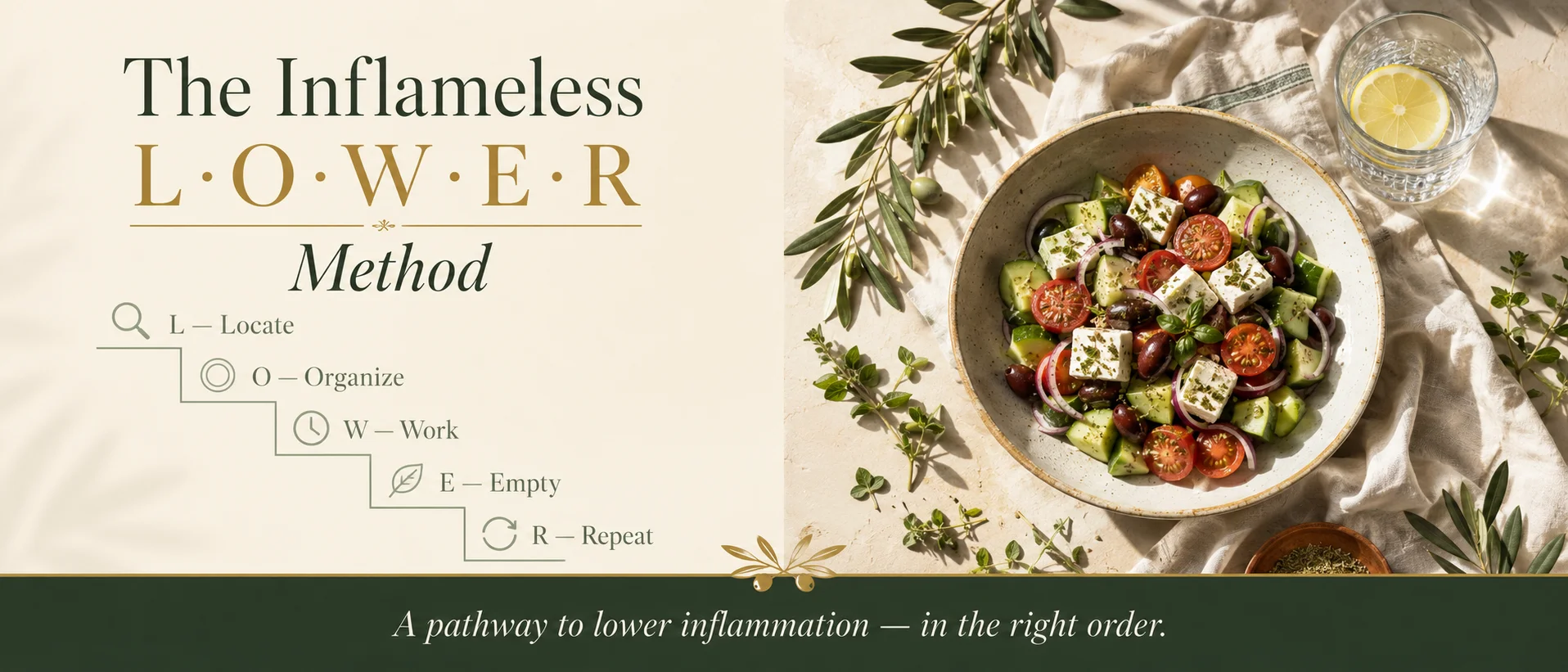
This is the foundation of how I work and it's the principle behind the Inflameless L.O.W.E.R. Method, the framework I've developed for women who eat healthily but still feel chronically inflamed.
The method works in five steps, each addressing a different layer of the inflammation load:
L : Locate your pattern. Before changing anything, identify your dominant signal pattern. Bloating after meals? Energy crashes at a specific time of day? Cravings that appear like clockwork? Symptoms that worsen under stress regardless of what you ate? Your pattern tells you where to start, and most women have one dominant pattern driving the majority of their symptoms.
O : Organize your plate. Not with a restrictive meal plan, but with a stable formula. Protein, fibre-rich plants, healthy fat, smart carbohydrate in the right proportion. Eaten at consistent times giving your blood sugar, your gut and your cortisol rhythm something predictable to work with.
W : Work with your body clock. Your hormones, digestion, cortisol and blood sugar all operate on a circadian rhythm. Morning habits in particular - the first hour of your day, when you eat, whether you eat before coffee, how you manage light and movement - have an outsized effect on how your body regulates inflammation for the rest of the day.
E : Empty the hidden load. Systematically reduce the non-food contributors to your inflammation bucket: sleep quality, stress inputs, environmental chemical load, ultra-processed ingredients hiding in otherwise healthy products. You don't need to live in a bubble - you need to remove the highest-impact, easiest-to-change contributors first.
R : Repeat what works. Consistency beats perfection, every time. Five default meals you can rotate. An emergency meal for chaotic days. A weekly kitchen rhythm. A system that functions when motivation is low - because that's when the body needs it most.
This is the foundation of the L.O.W.E.R. Method - the framework I've developed for exactly this pattern. Read the full method →
The question worth asking first
If you've been eating well for months or years and you're still bloated, still tired, still puffy after meals -the answer is not another elimination.
The answer is understanding your pattern.
Which of these sounds most like you?
- Your energy crashes and cravings hit at the same time every day, regardless of what you ate
- You feel better when you eat consistently but your schedule makes that nearly impossible
- You bloat after most meals, even meals you know are healthy
- You sleep enough hours but wake up unrestored
- You feel fine at home but react to things in restaurants, hotels or other environments
- Your symptoms are worse during stressful periods regardless of your food
Each of these points to a different dominant pattern and a different starting point for lowering your inflammation load.
If you want to find out which pattern is driving your symptoms, the best first step is identifying it precisely rather than guessing. I'm developing a free pattern-finding tool for exactly this - join my community on Skool.
In the meantime, the next article in this series looks at why anti-inflammatory diets so often fail to deliver results — and what the research actually tells us about what works instead.
References
- Furman, D. et al. (2019). Chronic inflammation in the etiology of disease across the life span. Nature Medicine, 25, 1822–1832. https://doi.org/10.1038/s41591-019-0675-0
- Sonnenburg, J.L. & Bäckhed, F. (2016). Diet–microbiota interactions as moderators of human metabolism. Nature, 535, 56–64. https://doi.org/10.1038/nature18846
- Irwin, M.R. & Opp, M.R. (2017). Sleep health: reciprocal regulation of sleep and innate immunity. Neuropsychopharmacology, 42(1), 129–155. https://doi.org/10.1038/npp.2016.148
- Besedovsky, L., Lange, T. & Born, J. (2012). Sleep and immune function. Pflügers Archiv — European Journal of Physiology, 463, 121–137. https://doi.org/10.1007/s00424-011-1044-0
- Chrousos, G.P. (2009). Stress and disorders of the stress system. Nature Reviews Endocrinology, 5, 374–381. https://doi.org/10.1038/nrendo.2009.106
- Kolb, H. & Mandrup-Poulsen, T. (2010). The global diabetes epidemic as a consequence of lifestyle-induced low-grade inflammation. Diabetologia, 53, 10–20. https://doi.org/10.1007/s00125-009-1573-7
- Calder, P.C. et al. (2017). Dietary factors and low-grade inflammation in relation to overweight and obesity. British Journal of Nutrition, 106(S3), S5–S78. https://doi.org/10.1017/S0007114511005460
- Kiecolt-Glaser, J.K. (2010). Stress, food, and inflammation: psychoneuroimmunology and nutrition at the cutting edge. Psychosomatic Medicine, 72(4), 365–369. https://doi.org/10.1097/PSY.0b013e3181dbf489
MEDICAL DISCLAIMER
The information in this article is intended for educational purposes only and does not constitute medical advice, diagnosis or treatment. It is not a substitute for professional medical consultation. If you are experiencing persistent or severe symptoms, please consult your doctor or a qualified healthcare provider before making changes to your diet or lifestyle.