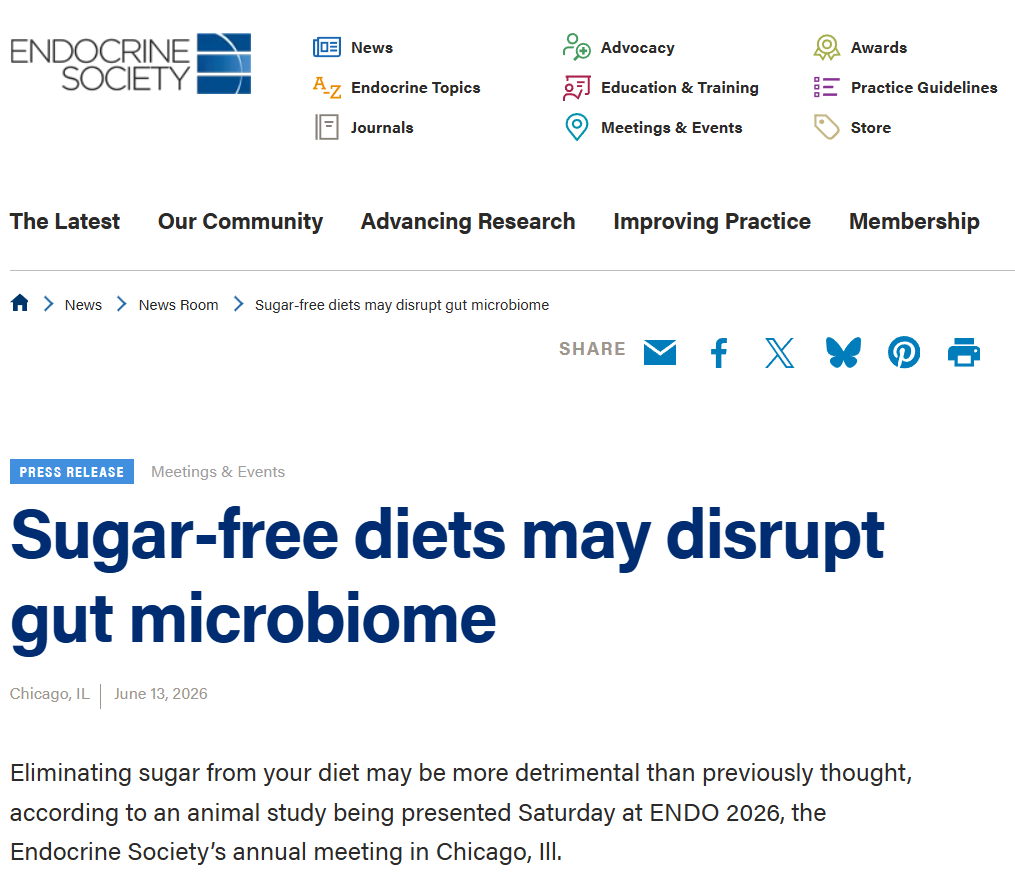
Last week, a study presented at ENDO 2026 (the Endocrine Society's annual meeting in Chicago) made the rounds on social media with headlines like "Cutting out sugar may be bad for your health" and "Sugar-free diets linked to inflammation and liver damage."
My inbox filled up. My clients sent screenshots. A few people in my community genuinely wondered whether they should add sugar back into their diet.
So let's talk about what the study actually found. And then let's talk about why this keeps happening - because this wasn't a one-off. It's a pattern, and understanding it is one of the most useful things you can do for your health.
What the study actually said
Researchers from the Dasman Diabetes Institute in Kuwait fed two groups of mice a low-fat diet. One group consumed some sucrose (table sugar). The other group ate the same low-fat diet with zero sucrose. After 16 weeks, the sugar-free group had developed worse blood sugar control, insulin resistance, gut microbiome disruption, intestinal inflammation and early signs of fatty liver disease.
Here's what the headlines didn't mention:
To keep calories equal between the two groups, the researchers replaced the sugar with starch. Which means the sugar-free diet wasn't just "the same diet minus sugar." It was a fundamentally different carbohydrate composition - one heavily skewed toward refined starch.
The researchers themselves noted this. In their own findings, they acknowledged that the negative effects "likely arose from the overall change in carbohydrate composition rather than sucrose removal."
In other words: the study didn't find that sugar is harmless. It found that replacing sugar with refined starch on an already low-fat diet produces metabolic chaos. Which, if you've been following nutritional science for more than five minutes, is not surprising at all.
We tested the low-fat, high-starch dietary pattern on entire populations in the 1980s. The results of that experiment are still visible in chronic disease statistics today.
Why the headlines got it wrong and why they always will
Here's where I want to be direct with you, because I think this matters more than the study itself.
Nutrition journalism has a structural problem. And it's not going away.
Science moves in iterations. A single study - especially an animal study, especially a conference presentation that hasn't yet been peer-reviewed - is a data point, not a conclusion. It raises questions. tt suggests directions for further research but it rarely, if ever, should change what you eat tomorrow.
But that's not how it gets reported. Because "preliminary mouse study raises interesting questions about carbohydrate composition" doesn't get clicks. "Sugar-free diets cause liver damage" does.
The media business model runs on attention. Attention is generated by surprise, fear and contradiction. Nutrition science is uniquely vulnerable to this dynamic because everyone eats, everyone has anxieties about what they eat and the field genuinely does produce surprising findings - which makes it easy to strip context and manufacture a headline that feels like a revelation.
The result is a cycle that's genuinely harmful. People whiplash between eating patterns based on headlines. They develop anxiety around food. They lose trust in science itself, because every few months "everything we knew was wrong."
Nothing was wrong. The headlines were just incomplete.
The questions nobody asks
When you read a nutrition headline, the relevant questions are almost never asked in the article itself:
Was this an animal study or a human trial? Mouse models are useful for generating hypotheses. They are not evidence that the same mechanism operates identically in humans. Mice are not small people.
How many subjects? The ENDO 2026 study used 12 mice. Twelve. That's a signal worth noting, not a mandate to change your diet.
Has it been peer-reviewed? Conference presentations are preliminary. Peer review exists specifically to catch methodological problems, confounding variables, and overclaimed conclusions. A study that hasn't been through that process is a work in progress.
Who funded it? Funding doesn't automatically invalidate findings, but it's relevant context, particularly in nutrition research where food industry funding has a documented history of influencing outcomes.
What does the rest of the literature say? A single study that contradicts decades of research should raise eyebrows, not change recommendations. Isolated findings that align with existing evidence are more meaningful than dramatic reversals.
None of this is cynicism. It's basic scientific literacy. And it's something the mainstream coverage of nutrition science consistently fails to model.
The ethics problem nobody wants to name
I want to say something plainly: publishing a headline that materially misrepresents a study's findings is not a neutral act. It's not just imprecision or oversimplification. When the misrepresentation causes people to make decisions about their health based on incomplete information, there is an ethical dimension that deserves to be named.
Clickbait in entertainment is annoying. Clickbait in health journalism causes real harm - to the people who change their diet based on a headline, to the scientists whose nuanced work gets flattened into a soundbite, and to public trust in the institutions that produce nutrition guidance.
The journalists writing these headlines are often not scientists. They're working under deadline pressure, optimising for engagement metrics and translating complex research for a general audience - which is genuinely difficult work. The problem is systemic, not always individual, but the system is producing bad outcomes. And every journalist should check and double check before publish.
And the people who pay the price are the ones trying to make sense of their health.
What you can do with this
I'm not suggesting you stop reading nutrition news. I'm suggesting you read it differently.
Treat headlines as invitations to ask questions, not announcements of facts. Look for the original study - most are accessible online. Read the methodology section, not just the abstract. Notice what the researchers themselves concluded versus what the coverage claims they concluded. Those two things are frequently not the same.
And when you're genuinely confused - when a headline seems to contradict something you thought you knew - that's actually a good sign. It means you're paying attention. Bring it to a practitioner who can help you evaluate it in the context of your own health picture.
Root-cause nutrition is not about keeping up with every new finding. It's about understanding the mechanisms well enough that when a headline tries to mislead you, something in you recognises it.
That's what we're building here.
References
Ahmad, R. (2026, June 14). Eliminating dietary sugar may disrupt gut health and promote inflammation. Presented at ENDO 2026, the Endocrine Society's Annual Meeting, Chicago, Illinois. [Conference presentation, not yet peer-reviewed]
Endocrine Society. (2026, June 14). Sugar-free diets may disrupt gut microbiome. endocrine.org. https://www.endocrine.org/news-and-advocacy/news-room/2026/ahmad-press-release-endo-2026
ScienceDaily. (2026, June 14). Scientists found a surprising problem with sugar-free diets. sciencedaily.com. https://www.sciencedaily.com/releases/2026/06/260614011843.htm
Disclaimer: This article is written for educational purposes only and does not constitute medical or nutritional advice. The study discussed is a preliminary animal model presented at a conference and has not yet undergone peer review. Always consult a qualified healthcare professional before making changes to your diet or health practices.