I've spent 13 years watching clients with celiac disease and non-celiac gluten sensitivity manage their condition the only way medicine has ever offered them: total avoidance, for life, with zero margin for error. No pill or backup plan. Just vigilance, forever - and the quiet dread of a restaurant kitchen you don't control.
That's the part I want focus on a bit here, because it's not really about gluten. It's about the cognitive load of never being able to relax around food. A shared fryer or a cross-contaminated cutting board. A well-meaning host who didn't realize soy sauce has wheat in it.
So when a research team in Barcelona announced they'd engineered an enzyme, derived from a carnivorous plant, that survives stomach acid long enough to dismantle gluten before it ever reaches the small intestine - I read the primary sources, not the headlines. Here's what's actually going on.
Why Your Stomach Is the Problem, Not the Solution
Most gluten-digesting enzyme supplements on the market fail for a boring, mechanical reason: your stomach runs at roughly pH 2. That's acidic enough to unfold and deactivate most enzymes before they get a chance to do anything. It's not that the enzymes are poorly designed - it's that they're being asked to work in an environment built to destroy proteins, because that's literally the stomach's job.
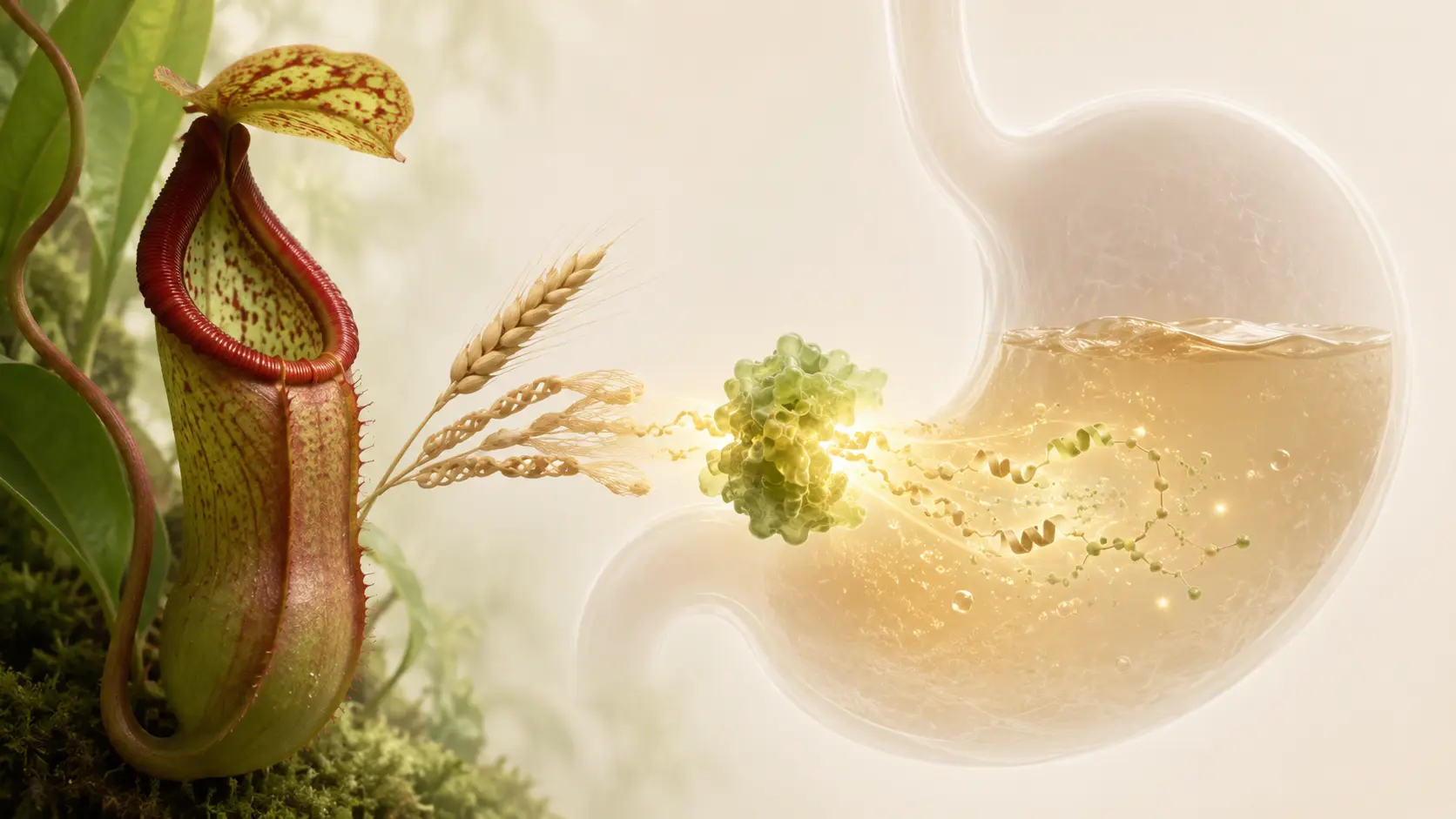
Researchers at the Institute of Molecular Biology of Barcelona (IBMB-CSIC), working with the University of Barcelona's Faculty of Pharmacy and Food Sciences, went looking for an enzyme that had already solved this problem in nature. They found it in Nepenthes, a genus of tropical pitcher plants that digest trapped insects using fluid that stays active at extreme acidity - because dissolving an exoskeleton requires exactly that.
Four years ago, the same CSIC group had already identified the relevant enzyme in the plant's digestive fluid, called neprosin, and shown it could cut gluten immunogenic peptides (GIPs) - the fragments that trigger the autoimmune cascade in celiac disease. The new work takes that a step further: an engineered variant of neprosin, named celiacase (celiacasa in the original Spanish and Catalan coverage), designed specifically to hit peak activity at gastric pH.
What It Actually Targets
Gluten isn't one molecule - it's a mixed bag of proteins, and one fragment in particular, the 33-mer peptide, is notoriously resistant to human digestive enzymes. It survives digestion intact, crosses into the small intestine, and in people with celiac disease, sets off the immune response that flattens intestinal villi and drives the downstream inflammation, malabsorption and symptoms.
In the CSIC-UB team's mouse model of celiac disease, animals given celiacase alongside gluten showed less intestinal damage, lower inflammation, a reduced antibody response, and less disruption to gut microbiota compared to those given gluten alone. The mechanism isn't mysterious once you see it laid out: celiacase works in synergy with pepsin - your own digestive enzyme - to break down cereal GIPs and wheat gliadin before they ever leave the stomach. One detail I actually appreciate as a practitioner: the researchers note celiacase stops being active once it's past the duodenum, so it isn't sitting around interacting with other proteins in the body after its job is done.
That's not villi regeneration by some novel growth mechanism. It's inflammation removal. Take away the trigger, and the gut does what it already knows how to do - rebuild.
What This Is Not
I want to be precise here, because "gluten-neutralizing enzyme" is exactly the kind of headline that gets misread as "eat whatever you want now." It isn't that, and the researchers are explicit about it.
This is still preclinical. Mouse model, not human trials. The team is pursuing patents and building a spin-off company as the next step toward clinical development. Nearly half a million people live with celiac disease in Spain alone, and until now their only management tool has been label-by-label, meal-by-meal avoidance. Celiacase isn't positioned to replace that. It's positioned as a safety net - something that could catch the cross-contamination you didn't see coming, not license to order the pizza.
Why I'm Tracking This
Most of what I write about here is root-cause: how chronic low-grade inflammation compounds over years, how the gut-immune interface gets disrupted, how removing a trigger lets tissue repair itself. Celiac disease is one of the clearest examples we have of that mechanism playing out in a single, well-characterized pathway - antigen in, immune response out, villi damage as the visible cost.
What's genuinely interesting about celiacase isn't that it's exotic (carnivorous plant enzymes make for a good headline, sure). It's that it's a rare case of engineering a fix for the actual chokepoint in the mechanism - gastric stability - rather than just producing another enzyme that works fine in a lab beaker and falls apart the moment it hits real stomach acid. That's the difference between a supplement that sounds promising and one that might eventually do something.
I'll be watching for the clinical trial data. If it holds up in humans the way it did in mice, this is worth paying attention to.
References
- Parc Científic de Barcelona. "Research led by IBMB-CSIC develops a recombinant molecule to treat celiac disease." https://www.pcb.ub.edu/en/research-led-by-ibmb-csic-develops-a-recombinant-molecule-to-treat-celiac-disease/
- Consejo Superior de Investigaciones Científicas (CSIC). "Una molécula terapéutica inspirada en una planta carnívora degrada el gluten y evita los síntomas de la celiaquía." https://www.csic.es/es/actualidad-del-csic/una-molecula-terapeutica-inspirada-en-una-planta-carnivora-degrada-el-gluten-y-evita-los-sintomas-de-la-celiaquia
- Agencia SINC. "Una molécula terapéutica degrada el gluten y evita los síntomas de la celiaquía." https://www.agenciasinc.es/Noticias/Una-molecula-terapeutica-degrada-el-gluten-y-evita-los-sintomas-de-la-celiaquia
- Medical Xpress. "Lab-designed molecule offers hope for celiac disease sufferers." https://medicalxpress.com/news/2026-05-lab-molecule-celiac-disease.html
- The Objective. "Una molécula terapéutica degrada el gluten y evita los síntomas de la celiaquía." https://theobjective.com/sociedad/ciencia/2026-05-15/molecula-degrada-gluten-sintomas-celiaquia/
Medical Disclaimer
This article is for educational purposes only and does not constitute medical advice. Celiacase is an experimental compound currently in the preclinical (animal-model) stage of research and is not available, approved, or validated for human use. It is not a treatment for celiac disease and should not be used as a reason to alter a gluten-free diet or medical management plan. Anyone with celiac disease, non-celiac gluten sensitivity, or wheat allergy should continue to follow the guidance of their physician or registered dietitian. If you have concerns about your gut health, inflammation, or dietary management, please consult a qualified healthcare provider.