For about a century, kidney stones got filed under "boring inorganic chemistry problem." Too much calcium, too much oxalate, not enough fluid to keep it all in solution, and eventually you've got a mineral clump throwing a party in your ureter. The advice that followed was equally tidy: drink more water, cut the spinach, watch your sodium. Case closed.
Except it wasn't closed. It was incomplete - which in physiology usually means "we hadn't looked closely enough yet."
The old model had a structural problem
The sterile-crystal theory explained a lot, but it never explained why some people with textbook-normal urine chemistry keep forming stones anyway, why stones and recurrent urinary tract infections show up together so often, or why antibiotics - which should, in theory, have nothing to do with a mineral clump - sometimes change recurrence patterns. A model that can't account for its own exceptions isn't wrong exactly. It's unfinished.
What UCLA actually found
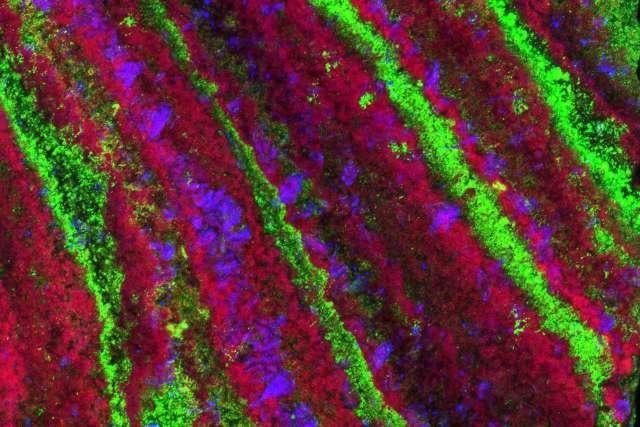
In early 2026, a team led by urologist Kymora Scotland and bioengineer Gerard Wong at UCLA, working with researchers at Washington University and the University of Illinois, took a much closer look at calcium oxalate stones - the type responsible for roughly 80% of all kidney stone cases. Using electron and fluorescence microscopy, they found something the sterile-crystal model had no room for: live bacteria, organized into biofilms, embedded inside the stones themselves.
Not sitting on the surface. Not contamination. Built into the architecture, in alternating bands - a layer of mineral, a layer of biofilm, another layer of mineral, another layer of biofilm - like sedimentary rock, if sedimentary rock had opinions. The crystals sitting closest to those biofilm bands were also smaller and more densely packed than crystals elsewhere in the same stone, which suggests the bacteria weren't just along for the ride. They were functioning as extra nucleation sites - more places for the mineral to start attaching.
This is a genuinely inconvenient finding for a theory that assumed stones were biologically inert. Calcium oxalate stones were specifically the ones classified as "noninfectious" - the type least expected to involve bacteria at all. And yet there they were.
Why "stones have bacteria in them" matters more than it sounds
Biofilms are not passive residents. In every other context we study them - dental plaque, chronic wounds, catheter infections - they behave the same way: they shift local pH, trap and concentrate minerals, build a sticky extracellular matrix that binds particles together, and resist being flushed out by normal fluid flow. There's no obvious reason the kidney would be the one organ where biofilm behavior suddenly stops mattering.
If a small bacterial colony can create a micro-environment that favors mineral deposition, that gives us a mechanism for several things the old model waved off as bad luck:
- Recurrent stones despite "perfect" labs
- The overlap between stones and urinary infections
- Antibiotics doing something, even if inconsistently, to recurrence
- The layered structure the imaging keeps turning up
None of this means bacteria cause stones outright, and the researchers are careful not to claim that. What the data supports is narrower and still significant: bacteria are present, organized, and structurally integrated into stone formation for a stone type that was assumed to be sterile chemistry from start to finish.
Where the bacteria are coming from: the forgotten urinary ecosystem
Medical training spent decades teaching that urine is sterile. Sequencing technology has since made that position untenable - there is a low-biomass but real urinary microbiome, shaped by hormones, immune activity, hydration, and gut health, among other inputs. Under normal conditions it stays quiet. Disrupted, certain organisms can migrate upward and establish the kind of micro-colonies that - per the UCLA data - may go on to seed stone formation.
The gut connection: this is where your oxalate actually gets handled
Here's the part I find more clinically useful than the biofilm imaging itself, because it's the part you can actually do something about.
Oxalobacter formigenes is a gut bacterium that specializes in breaking down dietary oxalate before it ever gets absorbed into the bloodstream. When colonization is intact, it functions as a first line of defense against hyperoxaluria. When it's depleted - and antibiotic exposure is one of the most well-documented ways this happens - intestinal oxalate absorption goes up, along with the amount of oxalate your kidneys eventually have to deal with. Reduced colonization has been directly associated with higher rates of recurrent calcium oxalate stone disease.
Put the two mechanisms together and you get a two-front problem: more oxalate arriving at the kidney, and a higher likelihood of microbes already present in the urinary tract to interact with it. That's not a coincidence stacking on a coincidence. That's one axis - gut, urinary tract, kidney - functioning as a single system, which is a sentence I could have written about almost any organ system in this newsletter and been right.
Worth noting for accuracy's sake: probiotic and synbiotic trials aimed at restoring O. formigenes colonization have so far produced inconsistent results on hard outcomes like confirmed stone recurrence, even when gut colonization itself was achieved. The mechanism is real. The supplement aisle has not caught up to it yet.
A quick word on fungi, because someone always asks
The UCLA paper focused on bacteria, but earlier reviews of stone composition have noted mixed microbial communities in some stones, including fungal elements. Fungi build biofilms of their own, alter local pH, bind minerals, and can persist through antibiotic exposure. This is a thinner body of evidence than the bacterial findings and I'm not going to oversell it, but it fits the same ecological logic and it's worth keeping on the radar as the field develops.
What this changes about prevention - and what it doesn't
Hydration, oxalate awareness, and citrate intake remain legitimate, evidence-backed tools. Nothing here retires them. What the biofilm findings add is a second axis that the old framework had no place for:
- Protecting oxalate-degrading gut flora rather than treating antibiotics as consequence-free
- Supporting general gut microbial diversity
- Paying attention to urinary tract and mucosal immune health, not just mineral counts
- Managing systemic inflammation as a background variable rather than an afterthought
None of this is "detox your kidneys" nonsense. It's closer to the opposite: it's an argument for stopping the practice of treating an organ as a standalone unit and started treating it as a node in a system that includes your gut and your immune function, because apparently that's what the tissue itself has been doing the whole time.
The takeaway
The 2026 UCLA findings don't overturn everything we knew about kidney stones. They add a piece the model was missing: stones may be shaped by microbial life, not just mineral chemistry. If you've done "everything right" on the hydration-and-oxalate checklist and still form stones repeatedly, this is at least a mechanistic reason why that isn't a personal failure of compliance - it may be a gap in the model you were following.
References
- UCLA Health. "Researchers discover a previously unknown bacterial component in kidney stone formation." January 2026. https://www.uclahealth.org/news/release/researchers-discover-previously-unknown-bacterial-component
- ScienceAlert. "Bacteria Play Previously Unknown Role in Kidney Stones, Study Finds." March 2026. https://www.sciencealert.com/bacteria-play-previously-unknown-role-in-kidney-stones-study-finds
- Wong, G.C.L., Schmidt, W., Yang, R., et al. "Intercalated bacterial biofilms are intrinsic internal components of calcium-based kidney stones." Proceedings of the National Academy of Sciences (2026). DOI: 10.1073/pnas.2517066123.
- NIH Research Matters. "Bacteria play key role in kidney stones." https://www.nih.gov/news-events/nih-research-matters/bacteria-play-key-role-kidney-stones
- Duncan, S.H., et al. "Effect of antibiotic treatment on Oxalobacter formigenes colonization of the gut microbiome and urinary oxalate excretion." National Library of Medicine, PMC. https://www.ncbi.nlm.nih.gov/pmc/articles/PMC8361114/
- Hoppe, B. "Direct correlation between hyperoxaluria/oxalate stone disease and the absence of the gastrointestinal tract-dwelling bacterium Oxalobacter formigenes." PubMed. https://pubmed.ncbi.nlm.nih.gov/10541258/
- Applied and Environmental Microbiology. "Forty Years of Oxalobacter formigenes, a Gutsy Oxalate-Degrading Specialist." https://journals.asm.org/doi/10.1128/aem.00544-21
- "Probiotic and Synbiotic Interventions Targeting Oxalate-Degrading Gut Bacteria for the Prevention of Kidney Stones: A Systematic Review." National Library of Medicine, PMC. https://www.ncbi.nlm.nih.gov/pmc/articles/PMC12707424/
Medical Disclaimer: This article is provided for educational purposes only and does not constitute medical advice, diagnosis, or treatment. Kidney stone disease has multiple underlying causes and risk factors that vary by individual, and the research discussed here represents an emerging area of investigation rather than established clinical protocol. If you have a history of kidney stones, urinary tract infections, or related symptoms, please consult a licensed physician or urologist for personalized evaluation and care. Do not discontinue or alter any prescribed medication, including antibiotics, based on the information in this article.