A 70kg goat can manufacture several grams of vitamin C in its liver on an ordinary day, and pushes that output several times higher under illness or physical stress. A dog does it too, and the rat, and even most fish and birds do it. You do not.
Every mammal on this list is running the same biochemical pathway humans are - glucose in, ascorbic acid out - except for a small group of primates, a couple of bat lineages and guinea pigs, all of whom independently lost the final enzyme in the chain at different points in evolutionary history. For us, that loss happened around 61 million years ago, and we have been dietarily dependent on an outside supply of vitamin C ever since.
This isn't a wellness talking point. It's a documented pseudogene sitting in your DNA right now, broken but present, doing nothing. Understanding why it broke - and why we've mostly stopped paying attention to the consequences - explains a lot about why "eat your vegetables" is not actually optional advice for humans the way it is for, say, a wolf.
The Broken Enzyme: What GULO Actually Is
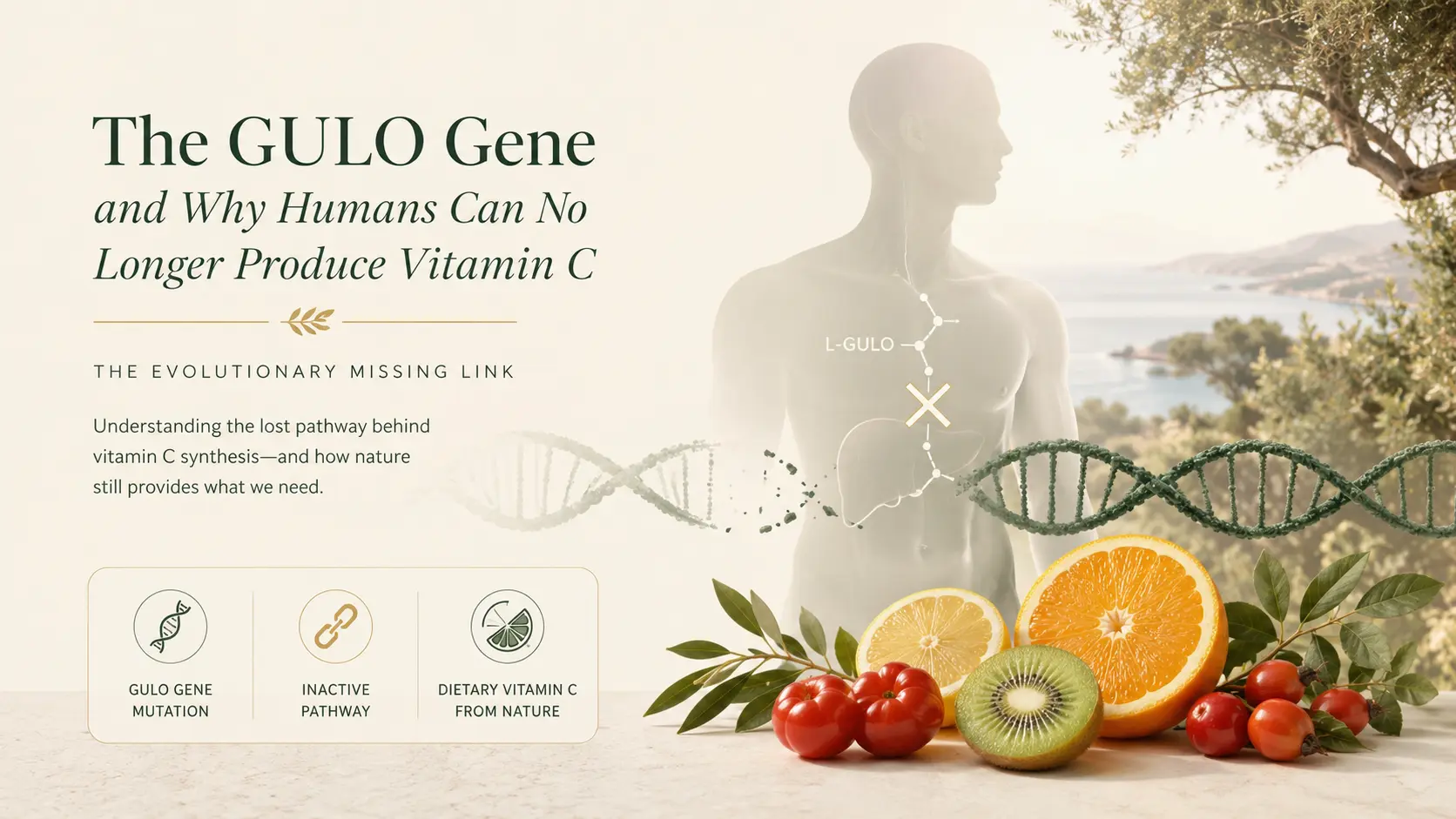
Vitamin C synthesis in mammals runs through a four-step pathway in the liver, converting glucose into ascorbic acid. The final step depends on an enzyme called L-gulonolactone oxidase or GULO. In most mammals, this gene works fine.
In humans and the rest of the haplorhine primate suborder (the branch that split off from the strepsirrhines, which kept the working gene), GULO is a pseudogene - present in the genome, riddled with disabling mutations, and completely non-functional. The non-functional remnant still carries multiple mutations in both guinea pigs and humans today. Researchers estimate this loss occurred roughly 61 million years ago in some mammals and primates, including human ancestors, coinciding with the split between the haplorhine suborder, which lost the enzyme, and the strepsirrhine suborder, which retained it.
Guinea pigs and certain fruit-eating bat species lost functional GULO independently, through entirely separate mutations - a case of the same evolutionary "mistake" happening more than once, in unrelated lineages, under presumably similar dietary pressure.
Why Would Evolution Allow This?
The leading explanation is the ascorbate-rich diet hypothesis: our ancestors lived in tropical forest canopies saturated with fruit, and dietary vitamin C intake was so high and so constant that a mutation knocking out endogenous synthesis carried no survival cost. Their habitat provided such abundant fruit containing ascorbate that the internal synthesis pathway became redundant. A mutation only gets selected against if it hurts survival or reproduction. If the environment is already flooding you with the nutrient, losing the machinery to make it yourself is metabolically neutral - maybe even a small energy saving.
Natural selection doesn't plan ahead. It has no way to "know" that 61 million years later, the descendants of these tree-dwelling primates would be living on a planet with depleted agricultural soil, produce picked before ripening and shipped for days or weeks, and industrial processing that strips out heat-sensitive nutrients before food reaches a plate. The trade was rational at the time it was made. It is no longer rational for the environment we actually live in.
The Cost of Losing It: What Vitamin C Actually Does
Ascorbic acid isn't a background vitamin - it's a cofactor required for enzymes that hydroxylate proline and lysine residues during collagen synthesis. Without it, the collagen triple helix can't stabilize properly. That single mechanism explains most of what deficiency does to the body: fragile blood vessels, poor wound healing, bleeding gums, and joint pain, because collagen is structural scaffolding for skin, blood vessel walls, bone and connective tissue everywhere.
It's also a major water-soluble antioxidant and an electron donor for a long list of enzymatic reactions, including ones involved in carnitine and neurotransmitter synthesis. When intake runs low, oxidative stress protection and structural repair both take a hit at the same time.
The Sailors Who Paid For It: A Short History of Scurvy
Long before anyone understood vitamins, sailors were the human population most exposed to the consequences of the GULO mutation, because long ocean voyages meant weeks or months with zero access to fresh produce. Between the 16th and 18th centuries, scurvy is estimated to have killed more British sailors than all naval battles combined.
When Vasco da Gama sailed to India in 1497, his crew noticed that citrus fruit seemed to keep scurvy symptoms at bay, but the observation didn't translate into consistent policy for centuries. It took Scottish naval surgeon James Lind, serving aboard HMS Salisbury, to run what's now considered one of the first controlled clinical trials in medical history. In 1747, Lind split twelve scorbutic sailors into pairs and gave each pair a different treatment - cider, diluted sulfuric acid, vinegar, seawater, a barley-based remedy, or citrus fruit. The two men given oranges and lemons recovered dramatically within about six days, while the other groups showed no meaningful improvement.
Even with a clear result in hand, it took the British Admiralty until 1795 - a year after Lind's death - to make citrus rations standard across the Royal Navy. Nobody involved knew why citrus worked. Vitamin C itself wasn't isolated until the late 1920s, when biochemist Albert Szent-Gyorgyi identified the compound, work that later earned him a Nobel Prize.
The lag between "we have overwhelming evidence this works" and "we act on it" is worth sitting with, because a version of that same lag is still running today - just for different reasons.
The Modern Version of the Same Problem
Today's version of the scurvy gap isn't lack of access. Fresh produce is everywhere, vitamin C supplements cost a few euros, and nobody in a Western supermarket is more than a few aisles from a source of ascorbic acid. And yet subclinical vitamin C deficiency remains more common than most people assume.
US national survey data (NHANES) put overall vitamin C deficiency at an estimated prevalence of about 5.9 percent in the general population, with older figures showing deficiency rates as high as 14 percent of men and 10 percent of women in earlier survey cycles. Globally, prevalence varies enormously by region, reported as low as 7.1 percent in the United States and as high as 73.9 percent in parts of northern India. And full-blown scurvy hasn't actually disappeared - it still shows up in developed countries, mainly in elderly, malnourished, or otherwise at-risk populations, sometimes misdiagnosed for weeks because clinicians no longer expect to see it.
Two mechanisms explain why deficiency persists despite abundant access:
1. Heat and storage destroy it before it reaches you. Ascorbic acid is one of the least stable nutrients in the food supply - sensitive to heat, light, oxygen, and time. Produce picked early for transport, stored for days, then cooked, loses a meaningful share of its original vitamin C content before it's eaten. Even something as ordinary as pasteurizing milk destroys the vitamin C it originally contained.
2. It's cheap, so it's psychologically discounted. Vitamin C supplementation is inexpensive relative to almost anything else in the wellness aisle, and price is a surprisingly powerful (and irrational) signal of perceived value. When something costs almost nothing, it's easy to assume it can't be doing much - so it gets skipped in favor of more expensive interventions that feel more serious, even when the underlying deficiency is real and measurable. Meanwhile, the recommended daily intake set by most health authorities reflects the minimum needed to prevent scurvy, not the amount that would optimally support collagen turnover, immune function and antioxidant capacity under real-world stress loads - the kind every other vitamin C-synthesizing mammal ramps up production to meet automatically.
What This Actually Means for You
You are, functionally, an animal with a superpower switched permanently off. Every other mammal in your local ecosystem gets to auto-adjust its internal antioxidant reserve in response to stress, illness or injury. You don't have that dial. The only lever available to you is diet - specifically, consistent intake of intact, minimally processed sources of vitamin C, rather than occasional large doses that arrive too late or get undermined by cooking and storage losses before they even count.
This is precisely the kind of quiet, unglamorous input the L.O.W.E.R. Method is built around - not chasing a trending supplement, but locating and correcting the ordinary metabolic gaps that accumulate into inflammation over time. A broken gene from 61 million years ago is not a design flaw you can argue with. It's a fixed constraint. The only variable you actually control is what you put on the plate to compensate for it.
References
- Henriques, S.F., Duque, P., López-Fernández, H., et al. (2019). Multiple independent L-gulonolactone oxidase (GULO) gene losses and vitamin C synthesis reacquisition events in non-Deuterostomian animal species. BMC Evolutionary Biology. https://doi.org/10.1186/s12862-019-1454-8
- Fischer, N., et al. Glut-1 explains the evolutionary advantage of the loss of endogenous vitamin C-synthesis: The electron transfer hypothesis. Evolution, Medicine, and Public Health, 2019. PMC6915226.
- Stephen, R., Utecht, T. Scurvy identified in the emergency department: a case report. Or comparable NHANES-based prevalence analysis, cited via: Scurvy: Rediscovering a Forgotten Disease. PMC10296835.
- Vitamin C Deficiency - StatPearls. NCBI Bookshelf, 2023. Global prevalence estimates and collagen synthesis mechanism.
- Scurvy in the Modern World: Extinct or Not? PMC8958866. Timeline of hypovitaminosis C progression to overt scurvy.
This article synthesizes findings from peer-reviewed evolutionary biology, biochemistry, and clinical nutrition literature. Individual study findings and prevalence estimates vary by population and methodology.
Medical Disclaimer: This article is for educational purposes only and does not constitute medical advice, diagnosis, or treatment. The information presented is based on published research but should not be used to self-diagnose or self-treat any health condition, including vitamin C deficiency or scurvy. Vitamin C needs vary by individual health status, medication use, and existing conditions, and high-dose supplementation can interact with certain medical treatments or conditions (including kidney disease and iron overload disorders). Always consult a qualified healthcare provider before making significant changes to your diet or supplement regimen, particularly if you have an existing medical condition or take prescription medication.