If you've ever told yourself "my body's just used to this diet now" - eating the same fried, sugary, processed stuff for years without obvious consequences - I want to gently push back on that idea today. A study that just landed in Pharmacological Research and is making waves in the metabolic health world for a very unexpected reason.
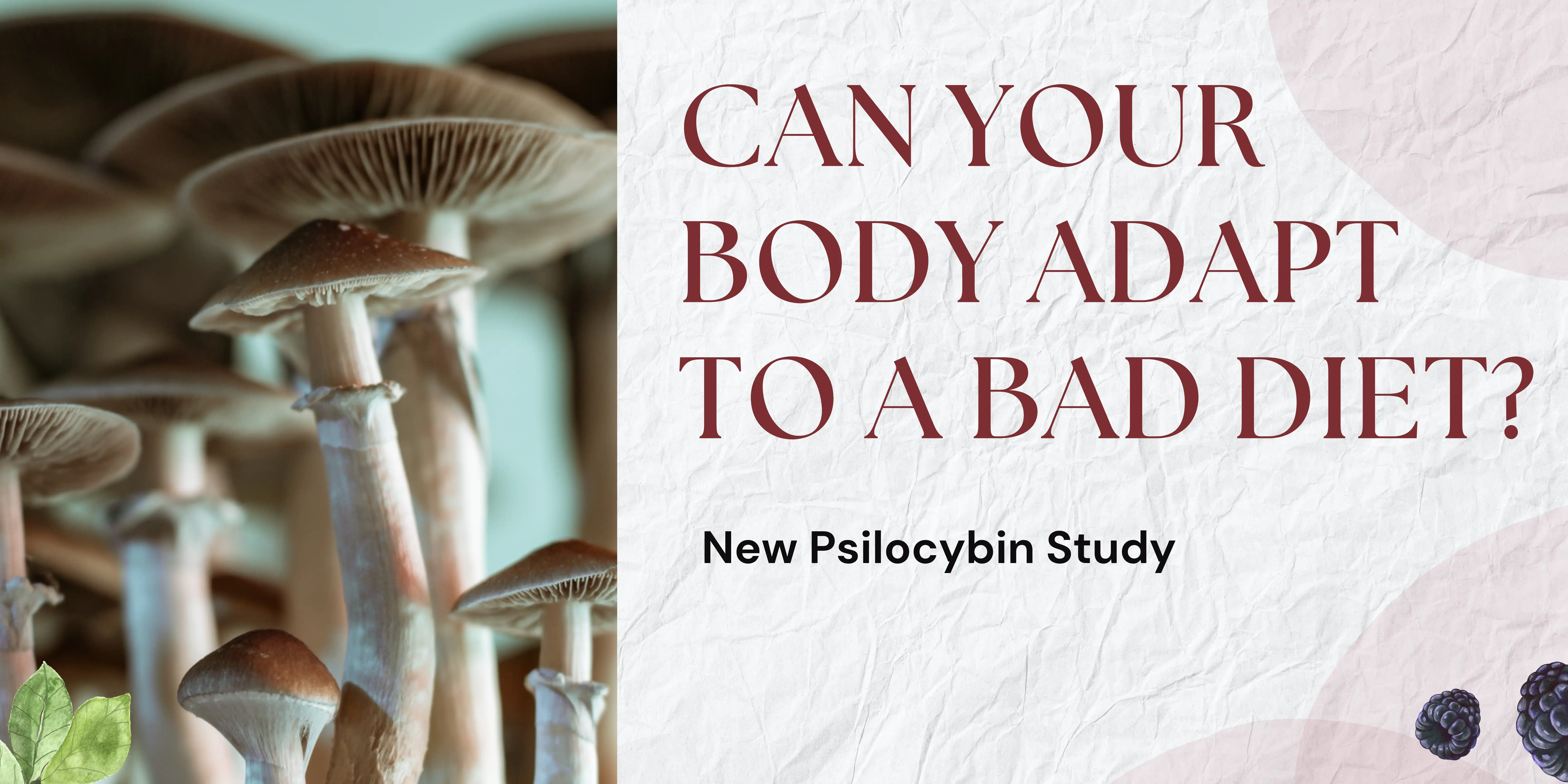
Spoiler: the answer to "can we adapt to a bad diet?" is basically no. Your body doesn't quietly adjust to chronic fat-and-sugar overload - it just suffers more slowly and more silently, than you'd think. But the way researchers proved this is the part that had me genuinely raising an eyebrow: they used low-dose, non-hallucinogenic psilocybin (yes, the compound from "magic mushrooms") to reverse the damage in mice. Let's get into it.
The Study, in plain English
A team of Italian researchers (Colognesi et al., 2025) wanted to test something that's been quietly buzzing in metabolic research circles: does psilocybin, completely separate from its psychedelic effects, have a direct effect on metabolic disease?
Here's what they did:
- Mice were put on a high-fat, high-fructose diet for 17 weeks - basically a rodent version of a diet heavy in fried foods and sugary drinks, designed specifically to trigger obesity, insulin resistance and fatty liver. After the first 5 weeks of damage had already set in, one group started getting a tiny, sub-psychedelic dose of psilocybin (0.05 mg/kg) daily for 12 weeks. A control group kept eating the same diet with no intervention.
- Then the researchers measured everything: body weight, liver tissue under the microscope, blood sugar, insulin sensitivity, muscle strength, and - because this is 2025/2026 and we have the tools for it - full transcriptomic and lipidomic analysis of liver and muscle tissue (basically a deep readout of which genes and fat molecules were behaving abnormally).
Check the 30 day Anti-Inflammatory Reset
What the study found
This is where it gets interesting. The mice that got low-dose psilocybin, despite staying on the exact same bad diet, showed:
Reduced body-weight gain compared to control mice still on the obesogenic diet. Lower liver steatosis (the fat buildup that defines fatty liver disease, now officially called MASLD (metabolic dysfunction-associated steatotic liver disease). Better blood sugar control and improved insulin sensitivity -meaning their cells were responding to insulin properly again instead of needing more and more of it to do the same job. Near-complete normalization of disrupted lipid and carbohydrate metabolism pathways in the liver, according to the multi-omics data. Improved muscle strength and function, which the researchers think is tied to restored leptin sensitivity (leptin is your "I'm full, stop eating, burn some energy" hormone and it stops working properly in obesity, a state called leptin resistance).
And - this is the detail worth highlighting - none of this came with psychedelic effects. The dose was low enough that there were no observable central nervous system changes in the mice. No trip, just metabolic repair.
The Mechanism: It's not what you'd guess
Psilocybin is famous for acting on the 5-HT2A serotonin receptor in the brain - that's the target responsible for the perceptual and mood effects people associate with psychedelics. So you'd assume the metabolic benefits ran through the same pathway, just at a lower dose.
Well, they didn't.
Using pharmacological tools and CRISPR/Cas9 gene editing in human cell lines, the researchers traced the metabolic effects to a completely different receptor: 5-HT2B, located in the liver. Blocking (antagonizing) this receptor appears to be the actual driver of the improved fat and sugar metabolism -independent of 5-HT2A entirely. In other words, this isn't a watered-down psychedelic effect. It's a separate, liver-specific mechanism that happens to be triggered by the same molecule.
That distinction matters enormously for where this research could go, because it means you could theoretically develop a drug that hits this pathway with zero psychoactive risk.
So, back to the real question: can we adapt to a bad diet?
Here's the part I want to sit with for a second, because I think it's the most important takeaway for anyone managing chronic inflammation or metabolic issues (hi, that's most of us reading this blog).
The control mice in this study didn't "adapt" to the bad diet. They didn't plateau into some stable, tolerable equilibrium. Their fatty liver, insulin resistance and metabolic dysfunction kept compounding the entire time, untouched, because nothing intervened. The body wasn't quietly making peace with chronic excess fat and fructose. It was accumulating damage the whole time, just without anyone (or anything) measuring it.
This tracks with what we already understand about insulin resistance and oxidative stress in humans. Feeling "fine" on a bad diet isn't evidence of adaptation but it's usually evidence that the damage is still subclinical. Mitochondria can keep grinding out ATP under a rising load of metabolic stress for a long time before symptoms show up. By the time fatigue, weight gain or lab numbers shift, the dysfunction has often been building for years. Adaptation, in the sense of "no harm done," doesn't appear to be a real phenomenon here, it's more that our detection threshold is just really, really slow.
What this study actually demonstrates is the opposite of adaptation: it took an external intervention - a specific receptor-blocking compound - to undo metabolic damage that diet alone wasn't going to resolve on its own, even with time. The body needed help reversing the dysfunction; it wasn't quietly fixing things in the background.
What this means for you (realistically)
I want to be very clear about something before anyone gets excited and starts microdosing mushrooms for their liver: this is a mouse study. The dose, delivery method and biology don't automatically translate to humans, and psilocybin's legal status varies enormously depending on where you live. This is early-stage mechanistic research, not a treatment protocol.
But it's a genuinely exciting signal for two reasons.
First, it adds to a growing body of evidence that metabolic dysfunction-associated liver disease, insulin resistance and obesity are tightly linked through fixable molecular pathways - they're not just "willpower problems," and they're not permanent once established.
Second, it reinforces something I talk about constantly here on Inflameless: the absence of symptoms is not the same as metabolic health. If you've been telling yourself you've "adapted" to your diet because you feel okay, this study is a good nudge to look a little closer - bloodwork, energy levels, sleep quality, inflammation markers - rather than waiting for obvious signs of trouble.
The real intervention available to us right now isn't a novel 5-HT2B-targeting drug (that's years away, if it ever reaches humans at all). It's still the boring, unglamorous stuff: reducing the fructose and ultra-processed fat load that creates this damage in the first place. The mice that never got the bad diet didn't need rescuing.
The bottom line
No, we don't adapt to a bad diet in any meaningful, damage-free way. What looks like adaptation is usually just slow-motion accumulation of metabolic dysfunction below the surface. This study is a striking proof of concept that even significant diet-induced liver and metabolic damage can be pharmacologically reversed - but the fact that reversal required a specific molecular intervention, rather than happening on its own, tells you everything about whether "the body just gets used to it" actually holds up.
It doesn't.
References
Colognesi, M., Gabbia, D., Signor, A., Sarill, M., Centofanti, L., Rinaldi, A., Cascione, L., Nunziata, S., Banzato, M., Mattarei, A., Finzi, G., Sonda, S., Pendin, D., Zanotto, I., Comai, S., Pasut, G., Alajati, A., Saponaro, M., Bucciarelli, L., Lunati, M.E., Guarato, G., Goggi, I., La Rosa, S., Morano, C., Paroni, R.C., Dei Cas, M., Daniele, G., Gentilucci, M., Pappagallo, M., Alimonti, A., Manfredi, P.L., Folli, F., & De Martin, S. (2025). Low, non-psychedelic doses of psilocybin as a novel treatment for MASLD, obesity and Type 2 Diabetes via 5-HT2B receptor-dependent mechanisms. Pharmacological Research. https://doi.org/10.1016/j.phrs.2025.108080
Hedrih, V. (2026, February 16). Low-dose psilocybin reduces weight gain and hyperglycemia in mice fed obesogenic diet. PsyPost. https://www.psypost.org/low-dose-psilocybin-reduces-weight-gain-and-hyperglycemia-in-mice-fed-obesogenic-diet/
Medical disclaimer: This article is for educational and informational purposes only and does not constitute medical advice. Psilocybin remains a controlled substance in many jurisdictions, and the research discussed here was conducted in animal models, not humans — findings may not translate to human physiology or outcomes. Always consult a qualified healthcare provider before making changes to your diet, supplement routine, or treatment plan, and never self-administer psilocybin or any controlled substance based on preclinical research.