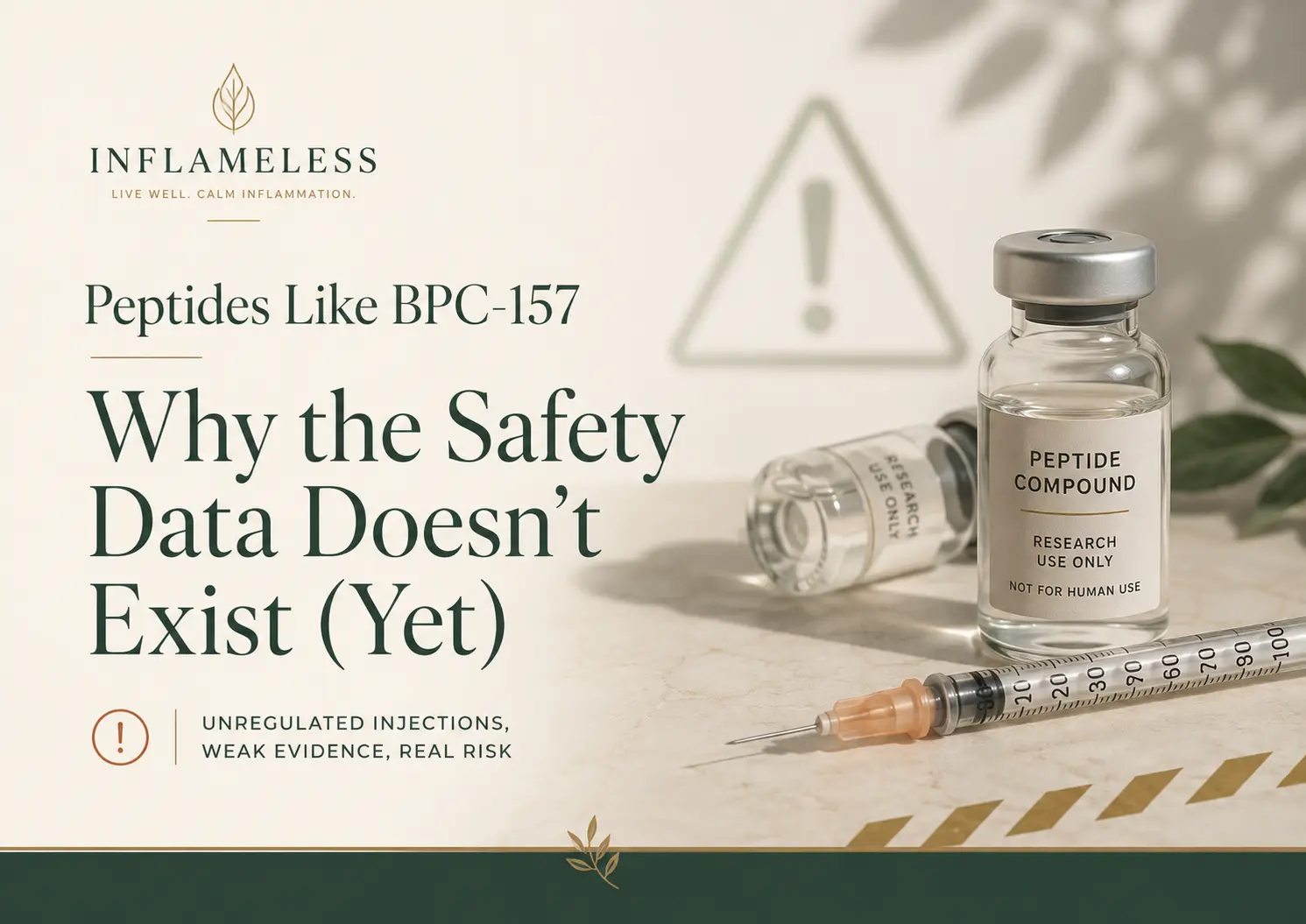
There's a specific kind of confidence that shows up around unregulated substances, and it always sounds the same: people have been doing this for years and nothing's happened. I hear a version of this every time a client mentions BPC-157, or a GLP-1 they sourced from a website with no pharmacist attached to it, or a "research chemical" a friend swore fixed their tendon.
I want to sit with that sentence for a minute, because it's doing a lot of quiet work it hasn't earned.
Nothing's happened - as far as you know. As far as anyone's tracked. And that distinction is the entire problem.
The chemistry is real. The safety claim isn't.
Peptides aren't nonsense. They're short chains of amino acids, and some of them do interesting, plausible things in cell cultures and animal models. BPC-157 has genuine preclinical interest behind it - VEGFR2 activation, anti-inflammatory signaling, tissue repair pathways that look promising on paper. That part isn't the lie.
The lie is the leap from "interesting in a petri dish" to "safe to inject into your body from a vial you bought online." Nobody has identified the human receptor this compound is supposed to act on. The overwhelming majority of what gets cited as evidence never left an animal study. And the FDA - not exactly known for dramatic overreach - has gone so far as to place BPC-157 in its highest internal risk category for compounding, explicitly citing that it doesn't have enough information to know whether the drug causes harm in humans. That's not bureaucratic caution. That's a regulator telling you, in plain language, we don't know what this does to a person, and neither do you.
The documentation trap
Here's the part that actually keeps me up at night, professionally.
When a substance is illegal to prescribe or sell for human use, something quiet happens to the data: it disappears. Not because nothing goes wrong, but because nobody involved has an incentive to report it. The person injecting a research chemical isn't calling their physician afterward to log it. The seller isn't submitting adverse event reports - they've already told you, in writing, it's "not for human consumption." If something goes wrong, it gets absorbed into a vague ER visit, misattributed to something else, or simply never spoken of again.
So when someone tells you peptides are safe because "there's no data showing otherwise," what they're actually saying is: there's no mechanism for that data to exist. Absence of evidence, in this specific case, isn't evidence of absence. It's evidence of a reporting vacuum.
We don't have to speculate about what that vacuum hides, either - we get glimpses of it whenever a related but legal gray market gets scrutinized. Compounded GLP-1s (semaglutide, tirzepatide) sit in a slightly different regulatory position than something like BPC-157, but they share the supply chain problem. By early 2025, the FDA's own reporting system already held over 455 adverse event reports tied to compounded semaglutide and over 320 tied to compounded tirzepatide - dosing errors from multidose vials serious enough to hospitalize people, contamination severe enough to require surgical drainage of infected tissue, counterfeit product entering the supply chain outright. And that's the fraction that made it into an official system. BPC-157 and its unregulated peers don't even have that fraction. They have nothing, because nothing was ever built to catch it.
What I actually think you should do with this
I'm not interested in being the wellness voice that just says "everything is dangerous, trust nothing." That's its own kind of lazy content, and it's not useful to you.
What I am interested in is this: if you're chasing a healing plateau, a stubborn inflammatory pattern, or a metabolic issue that has you eyeing a vial from a website with a disclaimer on it - the instinct underneath that search is legitimate. You're not wrong to want a faster answer. But the honest version of my job is telling you that "unregulated, undocumented, and untraceable" is not a faster answer. It's a different bet entirely, one where you're the only party absorbing the risk, and where a bad outcome has nowhere to go but silence.
There are mechanisms worth chasing that come with an actual evidence trail and a supply chain you can verify. That's a slower conversation. It's also the only one I can stand behind.
If you're navigating a healing plateau or a stalled inflammation pattern and want to talk through what's actually supported by evidence, that's exactly the kind of thing I dig into inside the L.O.W.E.R. Method .
References
- STAT News. "BPC-157: The peptide with big claims and scant evidence." February 3, 2026. https://www.statnews.com/2026/02/03/bpc-157-peptide-science-safety-regulatory-questions/
- Operation Supplement Safety (OPSS). "BPC-157: A Prohibited Peptide and an Unapproved Drug Found in Health and Wellness Products."
- FDA Adverse Event Reporting System (FAERS) pharmacovigilance study, published in Expert Opinion on Drug Safety, April 2025. PubMed ID: 40285721.
- ClinicalTrials.gov / ICH GCP Registry. "Clinical Trial on BPC-157, Bepecin" (NCT02637284) - Phase I safety and pharmacokinetics trial, PharmaCotherapia d.o.o., registered 2015, cancelled 2016. https://ichgcp.net/clinical-trials-registry/NCT02637284
- Vasireddi N, et al. "Healing or Hype? Systematic Review of BPC-157 in Orthopedic Sports Medicine Applications." AAOS 2025. https://index.mirasmart.com/AAOS2025/PDFfiles/AAOS2025-009087.PDF
Medical Disclaimer: This article is for educational purposes only and does not constitute medical advice, diagnosis, or treatment. It is not a substitute for professional medical consultation. Peptide compounds discussed here, including BPC-157 and compounded GLP-1 receptor agonists, are not FDA-approved for the uses described and carry documented safety risks, including contamination, dosing errors, and unknown long-term effects. Do not start, stop, or change any treatment based on this content. Always consult a licensed healthcare provider before making decisions about your health, and report any adverse reactions to a medical professional and to the FDA's MedWatch program.