Elena Maren ·

Anti-Inflammatory Lifestyle

Most "anti-inflammatory lifestyle" advice reads like a supplement ad wearing a lab coat. Turmeric lattes. Seed oil panic. A green smoothie and a vague promise that inflammation will simply... leave.

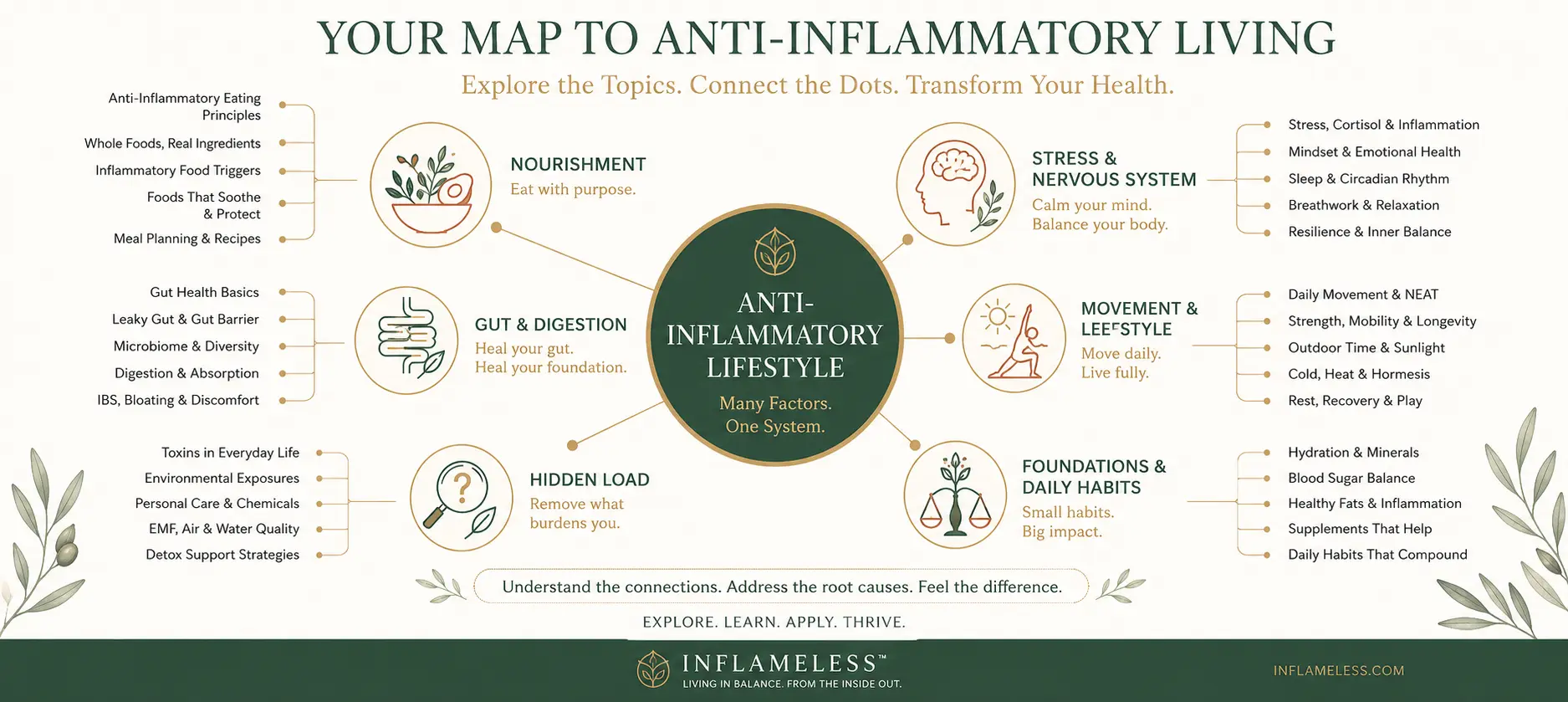
Here's what actually happens: inflammation is not one thing you fix, it's a downstream signal from several upstream systems - blood sugar regulation, cortisol rhythm, gut barrier function, sleep architecture, circadian timing. When those systems are under sustained load, your body responds the way it's supposed to. The problem isn't that you're doing it wrong. It's that most advice targets the symptom and ignores the mechanism.

This guide breaks an anti-inflammatory lifestyle down into its actual working parts - what drives chronic inflammatory load, which patterns tend to show up together, and where to start based on what's actually happening in your body, not what's trending this week.

This guide is written by Elena Maren, a licensed nutrition specialist with 13 years of clinical practice focused on root-cause, anti-inflammatory health. It's built on physiology, not trends - no supplement stacks, no 30-day miracle claims, no "just eat clean" advice that ignores why the last five attempts didn't work.

Everything here is organized around mechanism: what's actually driving inflammatory load in your body, and why the same symptom can have entirely different root causes from one person to the next.

What is an anti-inflammatory lifestyle?

An anti-inflammatory lifestyle is a set of daily inputs - food, sleep timing, movement, stress load, light exposure - structured to reduce the frequency and intensity of your body's inflammatory response, rather than eliminating inflammation itself.

That distinction matters. Inflammation isn't the enemy. It's a repair mechanism - the same process that heals a cut or fights an infection. The issue is when that mechanism gets triggered too often, for too long, by things that aren't actual threats: chronically elevated blood sugar, disrupted cortisol rhythms, a compromised gut lining, poor sleep architecture. The response doesn't turn off. It just runs in the background, low-grade, all the time.

Most inflammation protocols target one input in isolation - cut sugar, take an omega-3, sleep eight hours - and then can't explain why symptoms persist. That's because these systems are interdependent. Cortisol dysregulation raises blood sugar. Poor sleep disrupts cortisol. A disrupted gut barrier amplifies immune signaling regardless of what you eat. Fixing one lever without accounting for the others produces partial, unstable results.

"I wasn't doing it wrong. I was doing the wrong thing well."
- Elena Maren

The Steps

Anti-Inflammatory Lifestyle

Featured Articles

Vitamin D and Inflammation: What Your Levels Are Really Doing

Vitamin D isn't just a bone nutrient - it's a hormone with receptors in nearly every immune cell, and deficiency releases a key brake on inflammatory signaling. Read the actual mechanism: how sunlight and skin cholesterol compete for the same precursor molecule, why sun exposure and oral supplements produce different biological effects despite raising blood levels equally, and why an active outdoor lifestyle often isn't enough to correct deficiency - especially with age, skin tone, or limited midday sun. Includes the optimal testing range, the six-step correction framework, and why "more time outside" is not the same as "sufficient vitamin D."

Read more

5 Simple anti-Inflammatory food swaps for better daily energy

Afternoon energy crashes are often less about sleep and more about the inflammatory load created by processed foods, refined sugar, and industrial seed oils. This article walks through five practical swaps - sugary cereal to a berry-and-nut bowl, seed oils to extra virgin olive oil, refined bread to sourdough or quinoa, flavored yogurt to plain kefir, and commercial energy bars to almonds with dark chocolate - explaining the specific mechanism behind each one, from blood sugar stability to gut microbiome support. The throughline: sustainable energy comes from metabolic flexibility, not calorie restriction or willpower.

Read more

Your Gut Is Talking to the Brain. In Autism, Scientists Are Finally Listening.

Emerging autism research is looking past the brain and into the gut. This article covers two lines of evidence: a randomized, placebo-controlled trial testing kefir-derived probiotics in children with ASD, which showed improvements in adaptive behavior and drops in inflammatory and stress markers - though results against placebo didn't reach statistical significance - and a longer-term study on Microbiota Transfer Therapy, where gastrointestinal and behavioral improvements continued growing two years post-treatment.

Read more

From the Shop

The Cortisol Code

If your inflammatory load traces back to a cortisol rhythm that's stuck in "on," diet changes alone won't fix it. The Cortisol Code is a 14-day circadian reset built around when you eat, move, and wind down - not just what's on your plate.

€27 · Instant download · Start tonight

Get It Here →
The Cortisol Code

Quick Answers to Common Questions

Is intermittent fasting anti-inflammatory?

It depends on your cortisol pattern, not the fasting itself. For someone with a stable stress response, fasting windows can support blood sugar regulation. For someone already running high cortisol, prolonged fasting can raise it further and work against you. Read more

Can stress alone cause inflammation, even with a "perfect" diet?

Yes. Chronic cortisol elevation raises blood sugar and disrupts gut barrier function independent of what you eat. This is why "eating clean" sometimes doesn't move the needle - the driver isn't dietary. Find out more

How long before I notice a difference?

Most people see early shifts (energy, sleep, digestion) within 2-3 weeks of addressing their actual driver. Full inflammatory markers take longer - typically 8-12 weeks of consistent change. Find out more

Related Pillars