For years, the ultra-processed food conversation has had one settled villain: the ingredient list. Too much sodium. Too much added sugar. Too much refined starch pretending to be food. Fix the nutrients, the logic goes, and you fix the food.
A new observational study out of Tufts University's Food is Medicine Institute, published in the American Journal of Public Health, just made that logic a lot less comfortable to hide behind.
The study, in plain terms
Researchers pulled data from ten cycles of the National Health and Nutrition Examination Survey (NHANES), spanning 1999 to 2018, linked to death records through the same period. Every participant had logged at least one detailed 24-hour dietary recall. The team classified foods two ways: by degree of industrial processing, and separately by nutritional quality using a standard scoring system that accounts for saturated fat, added sugar, and sodium.
That second layer is what makes this study worth your attention. Instead of asking "do people who eat more ultra-processed food have worse health outcomes" - which has been asked and answered many times over - they asked a sharper question: if you strip out the nutrient content entirely and look only at how processed the food was, does the association survive?
It did.
For every 10% increase in calories coming from ultra-processed foods, participants showed worse markers across the board - higher body weight, poorer blood sugar regulation, higher blood pressure, less favorable cholesterol. Rates of diabetes, metabolic syndrome, and cancer tracked the same direction, along with a modestly elevated risk of death during the study period. And critically: these associations held even after accounting for the actual sodium, sugar and saturated fat content of the foods people ate. The processing itself carried an independent signal.
Why this matters more than another "UPF is bad" headline
This isn't a bigger, scarier version of the same finding. It's a different finding.
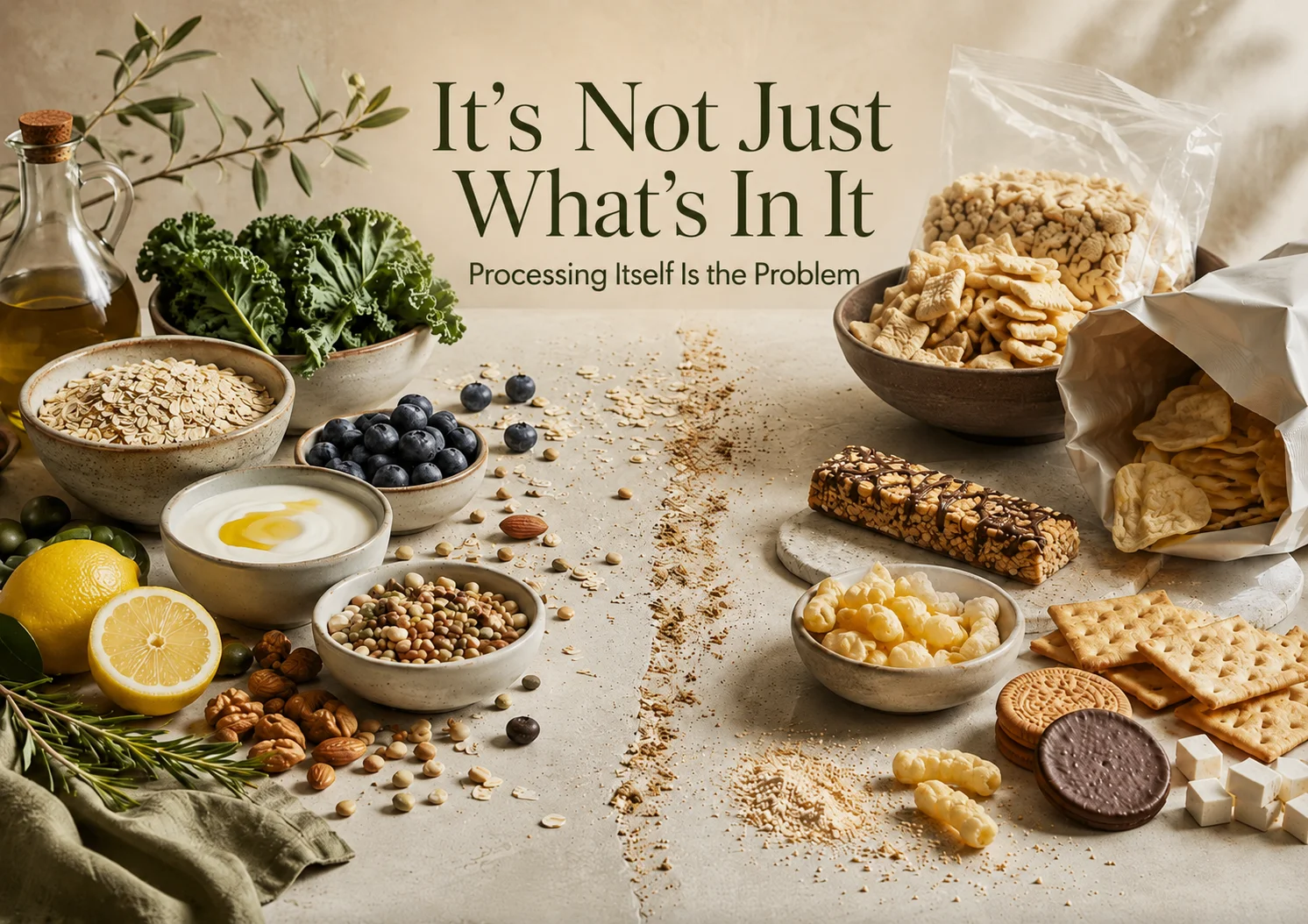
If nutrient content fully explained the risk, then a reformulated ultra-processed snack - same industrial process, same additive load, less sugar and sodium - should perform roughly as well as a whole food with a similar nutrient profile. This data says it doesn't. Something about the process of turning food into an ultra-processed product changes how your body responds to it, independent of what's listed on the nutrition panel.
The study's senior author pointed to a few likely culprits: disruption of a food's cellular structure, loss of naturally occurring beneficial compounds during processing, additives themselves, and chemical migration from packaging. None of these show up on a nutrition facts panel. All of them are plausible mechanisms for driving the kind of low-grade, chronic inflammatory load that sits underneath most of the conditions this study tracked - insulin resistance, dyslipidemia, cardiovascular risk and a subset of cancers.
That's the part I want to sit with for a second, because it maps onto something I see constantly in client work and in my own history: doing the "healthy" thing on paper and still getting an inflammatory result. Swapping a full-sugar cereal for a "protein" version with the same ultra-processed base. Choosing the reduced-sodium version of a product that was never food to begin with. The nutrient math looks better. The physiological experience doesn't necessarily follow.
The mechanism, a little deeper
Whole foods aren't just nutrient carriers - they're structures. Fiber matrices, cell walls, intact proteins. Digestion is partly a demolition process, and the pace of that demolition affects everything downstream: how fast glucose hits your bloodstream, how your gut microbes interact with what arrives intact versus pre-broken-down, how much of a satiety signal your gut actually gets to send before the meal is over.
Ultra-processing does a lot of that demolition before the food ever reaches you. Extrusion, industrial emulsification, and reconstitution can strip or radically alter that structure - which is a large part of why ultra-processed foods tend to be eaten faster, digested faster, and satisfy less per calorie, regardless of what the ingredient list says.
Layer on additives - emulsifiers, gums, artificial sweeteners - a number of which have their own emerging evidence for disrupting gut barrier function and microbial balance, and you have a second pathway to inflammatory load that has nothing to do with sugar or sodium counts.
Then there's packaging. Materials in contact with food for shelf-stable products can migrate trace compounds into the food itself, an exposure route nutrition labels were never built to capture.
None of this requires a conspiracy. It requires acknowledging that "processed" was never really a synonym for "worse nutrients" - it was always also a description of a different physical thing arriving in your gut.
What to actually do with this
I'm not going to tell you to "eat clean" or "avoid processed foods," because those phrases have been drained of meaning by a thousand infographics and they don't tell you anything actionable. Here's what I'd actually suggest:
- Stop trusting the reformulation. A "better for you" version of an ultra-processed product is still an ultra-processed product. It may be a smaller problem, but the processing-independent risk this study identified doesn't disappear because the sugar content dropped.
- Weight your plate toward structural intactness, not just macros. A meal built around foods that still resemble what they were before they were harvested or slaughtered gives your gut a slower, more complete digestive process - which is the mechanism, not just a nice idea.
- Treat additive load as its own variable. Long ingredient lists with multiple gums, emulsifiers, and stabilizers are worth noticing even when the sugar and sodium numbers look fine. This is a separate axis of risk from the one your nutrition app is tracking.
- Don't confuse "convenient" with "ultra-processed." Frozen vegetables, canned beans, plain yogurt - these are processed in the boring, non-industrial sense and don't carry the same signal. The category that matters here is industrial reconstruction, not "came in a package.
If you've been doing everything the nutrient-counting version of "healthy eating" asked of you and still feel inflamed, foggy, or stuck - this is one more piece of evidence that the missing variable might not be a macro you haven't optimized yet. It might be the structural and chemical reality of what you're actually putting in your gut, which no nutrition label was designed to show you.
References
- Hatta-Langedyk J, Wang L, Fan B, Shi P, Mozaffarian D, et al. Ultra-processed Food Intake, Nutritional Quality, and Health Outcomes: A NHANES 1999-2018 Analysis. Am J Public Health. 2026. DOI: 10.2105/AJPH.2026.308499
- Monteiro CA, Cannon G, Levy RB, et al. Ultra-processed foods: what they are and how to identify them. Public Health Nutr. 2019;22(5):936-941. DOI: 10.1017/S1368980018003762
- Menegassi B, Vinciguerra M. Ultraprocessed Food and Risk of Cancer: Mechanistic Pathways and Public Health Implications. Cancers. 2025;17(13):2064. DOI: 10.3390/cancers17132064
- Dicken SJ, Jassil FC, Brown A, et al. Ultraprocessed or minimally processed diets following healthy dietary guidelines on weight and cardiometabolic health: a randomized, crossover trial. Nat Med. 2025;31(10):3297-3308. DOI: 10.1038/s41591-025-03842-0
- Chang K, Gunter MJ, Rauber F, et al. Ultra-processed food consumption, cancer risk and cancer mortality: a large-scale prospective analysis within the UK Biobank. EClinicalMedicine. 2023. DOI: 10.1016/j.eclinm.2023.101840
Medical Disclaimer: This article is for educational purposes only and does not constitute medical advice, diagnosis, or treatment. The research discussed is observational and demonstrates association, not proven causation. Always consult a qualified healthcare provider before making changes to your diet, particularly if you have an existing health condition or are taking medication.