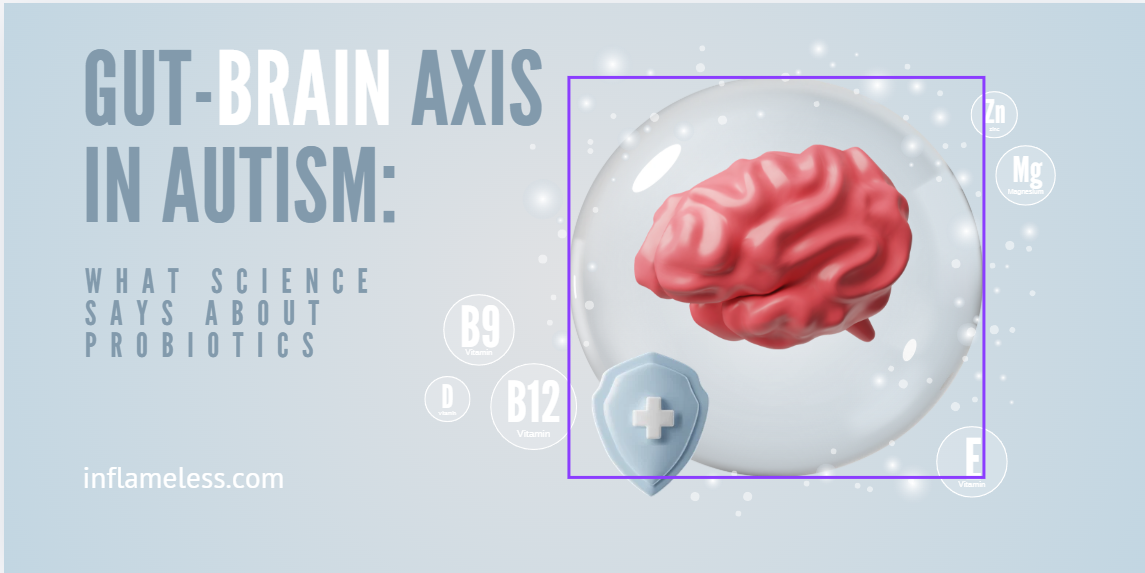
Let me ask you something: when you hear the word "autism," what part of the body comes to mind first?
The brain, obviously, or maybe the nervous system. Almost nobody's first instinct is the gut.
And yet some of the most interesting autism research happening right now isn't coming out of neurology labs. It's coming out of microbiome labs. Researchers feeding kids kefir cultures, transplanting entire microbial ecosystems from healthy donors into children who have never, not once, had a normal bowel movement.
This is not where I expected this story to go either. But once you see the data, it's hard to look away.
The study that reopened the conversation
Earlier this year, BMC Pediatrics published a trial that's been making the rounds in integrative health circles, and for good reason. Researchers ran a proper randomized, double-blind, placebo-controlled trial (the gold standard, no shortcuts) on 182 children with Autism Spectrum Disorder, ages 3 to 11. One group got a placebo. Two groups got different kefir-derived probiotic blends, labeled K11 and K11-TMAX. Nobody, not the parents, not the kids, not even the researchers scoring the outcomes, knew who was getting what until the data was unblinded.
Ninety days later, here's what showed up.
Children in both probiotic groups improved meaningfully on the Vineland-3, the gold-standard scale for adaptive behavior (communication, daily living skills, socialization, the stuff that actually shapes quality of life day to day). Clinical autism severity scores on the ADOS-2 and CARS moved in the right direction too.
And then there's the part that made me sit up.
Underneath the behavioral shifts, their biology was changing.
C-reactive protein dropped. That's your go-to marker for systemic inflammation, and it went down.
Cortisol dropped. Insulin dropped. Two hormones that, when chronically elevated, keep a body locked in a stress-and-inflammation feedback loop.
The gut microbiome itself shifted toward something healthier — more beneficial Lactobacillus, less E. coli sprawl.
Read that list again. This wasn't a study measuring one isolated marker but the child's entire internal terrain.
Now for the honest part, because I'm not in the business of hype
Here's where I have to put my nutrition-professional hat back on.
When researchers compared the probiotic groups directly against the placebo group, the difference on the primary outcome didn't reach statistical significance. The kids on probiotics improved. The kids on placebo, in some measures, also improved somewhat. The gap between them wasn't large enough to call definitive.
This happens constantly in autism research, for a reason that's almost poetic once you think about it: every child with ASD is biologically distinct in ways that don't show up cleanly when you average across a group. What helps one child's gut may barely register in another's. The researchers themselves were careful here. Their conclusion wasn't "kefir treats autism." It was "this justifies bigger, longer trials before anyone makes that claim." And we should respect that restraint.
But kefir is just the gentle end of something much bigger
Probiotic supplementation is, biologically speaking, a whisper. You're introducing a small, curated group of beneficial microbes and hoping they find a foothold.
There's a far more radical intervention being studied, and the data behind it is honestly kind of stunning.
It's called Microbiota Transfer Therapy, and Arizona State University ran what might be the most quietly remarkable longitudinal study in this entire field.
Picture this: eighteen children with ASD and severe, lifelong gastrointestinal problems (we're talking chronic constipation or diarrhea since infancy, with literally no period of normal gut health on record) went through an intensive protocol: a short course of antibiotics to clear out the existing gut ecosystem, a bowel cleanse, and then an extended fecal microbiota transplant from healthy donors, delivered over several weeks.
At the end of treatment, gastrointestinal symptoms dropped by roughly 80%.
That number alone would be newsworthy. But the researchers didn't stop there. They came back two years later to see what had stuck.
And this is the part that genuinely gave me chills when I first read it.
The improvements hadn't faded. They had kept growing.
Two years out, GI symptoms were still down by close to 60% from baseline. Autism severity, scored independently by a clinical evaluator using the CARS scale, had improved by 47% from where these children started, nearly double the improvement seen right after treatment ended. At the start of the trial, 83% of these children were rated as having severe autism. Two years later, only 17% still fell in that category, and 44% had dropped entirely below the diagnostic threshold for ASD.
Let that sit for a second. A one-time, weeks-long intervention on the gut, with effects still compounding two full years later.
The microbiome data backs up the story almost too cleanly. Beneficial bacteria like Bifidobacterium and Prevotella, species that tend to run low in autistic guts compared to neurotypical ones, stayed elevated at the two-year mark. Prevotella in particular is tied to butyrate production, a compound your intestinal lining quite literally feeds on to stay intact and non-inflamed.
Now, I want to be precise here, because precision matters more than excitement. This was an open-label trial, meaning there was no placebo arm, and autism symptoms can be unusually stable over years without any intervention at all, so we can't rule out other factors entirely. The researchers say so themselves, explicitly, in their own paper. What they're calling for next is exactly what the kefir researchers called for: a proper double-blind, placebo-controlled trial, at scale. That work is already underway, with active trials registered and recruiting.
Why would the gut have this much influence over behavior in the first place?
This is the question that used to keep me up at night when I was first diving into the gut-brain axis literature, and the mechanism, once you understand it, makes the whole thing click into place.
Your gut lining is one cell layer thick. That's the entire barrier between the trillions of microbes living in your intestines and your bloodstream. When that barrier becomes compromised (what we call increased intestinal permeability, or "leaky gut" in plainer language) bacterial byproducts and inflammatory triggers slip through into systemic circulation. From there, they don't stay contained to the gut. They reach the bloodstream, they reach the immune system, and through several well-mapped pathways, they reach the brain.
A body fighting a low-grade, chronic inflammatory fire is a body that struggles to regulate mood, sleep, sensory processing and behavior, regardless of what's driving that fire. For a neurotypical adult, that might show up as brain fog or irritability. For a child with ASD, whose nervous system is already processing the world differently, an added layer of systemic inflammation can amplify every sensitivity that child is already navigating.
This is also, by the way, exactly why so many autistic children struggle with chronic constipation, reflux, and abdominal pain that often gets dismissed or undertreated. It was never a coincidence sitting beside the autism. For a meaningful number of these kids, it may be mechanistically connected to it.
So what do we actually do with this, practically?
I want to be careful with this section, because this is exactly the place where wellness content tends to overpromise.
We are not talking about curing autism through the gut. Autism is a complex neurodevelopmental condition with deep genetic roots, and no amount of kefir or fecal transplant research changes that fact. Anyone telling you otherwise is selling you something, and you should walk away.
What the research does support is something more modest, and honestly more useful: reducing gut-level inflammation removes a significant biological burden from a child's body. If a child is dealing with daily abdominal pain, chronic constipation or a gut environment in a constant state of low-grade alarm, addressing that isn't a cosmetic fix. It's removing one major source of physical distress that a child may not have the language to fully express, but that is very plausibly shaping their mood, sleep and capacity to engage.
A calmer gut tends to produce a calmer, more available nervous system. And a calmer nervous system is simply more receptive, to communication, to connection, to the behavioral and educational therapies that remain the backbone of autism support.
That's not a miracle claim. It's a biologically reasonable one, and the data we have so far, imperfect and early as it is, points in that direction consistently across multiple independent research groups.
If there's one thing I want you to take from this, it's that the gut-brain axis in autism has stopped being a fringe theory whispered about in integrative health circles. It's being studied with proper blinding, proper placebo arms, and proper long-term follow-up, in real academic institutions, published in real peer-reviewed journals.
We're not at the finish line. But we are, undeniably, somewhere on the road.
The gut-brain connection is not a metaphor. It is a two-way conversation your body is having right now - and most of us have no idea what it's saying. Inside the Inflameless Living community we go deeper on exactly this: the microbiome, the nervous system, and the practical steps that actually shift things. Join us → Click here to see the Skool Community!
References
de Queiroz, S.A.L. et al. "Kefir-derived probiotic mixture for children with autism spectrum disorder: a double-blind randomized clinical trial." BMC Pediatrics, 2026. https://www.springermedicine.com/autism-spectrum-disorder/autism-spectrum-disorder/kefir-derived-probiotic-mixture-for-children-with-autism-spectru/51954398
Kang, D-W. et al. "Long-term benefit of Microbiota Transfer Therapy on autism symptoms and gut microbiota." Scientific Reports, 2019. https://doi.org/10.1038/s41598-019-42183-0
Systematic review of fecal microbiota transplantation in pediatric ASD. PMC. https://pmc.ncbi.nlm.nih.gov/articles/PMC10017995/
"Fecal Microbiota Transplant for Immune Modulation in Autism." ClinicalTrials.gov, NCT06290258.
Disclaimer
This article is for educational purposes only and does not constitute medical advice, diagnosis, or treatment. The information shared here is intended to support general understanding of the gut-brain axis and emerging autism research, and is not a substitute for the guidance of a qualified healthcare professional, particularly when it comes to your or your child's specific medical or developmental care. Always consult a physician or other qualified health provider before starting any new dietary supplement, probiotic, or intervention.