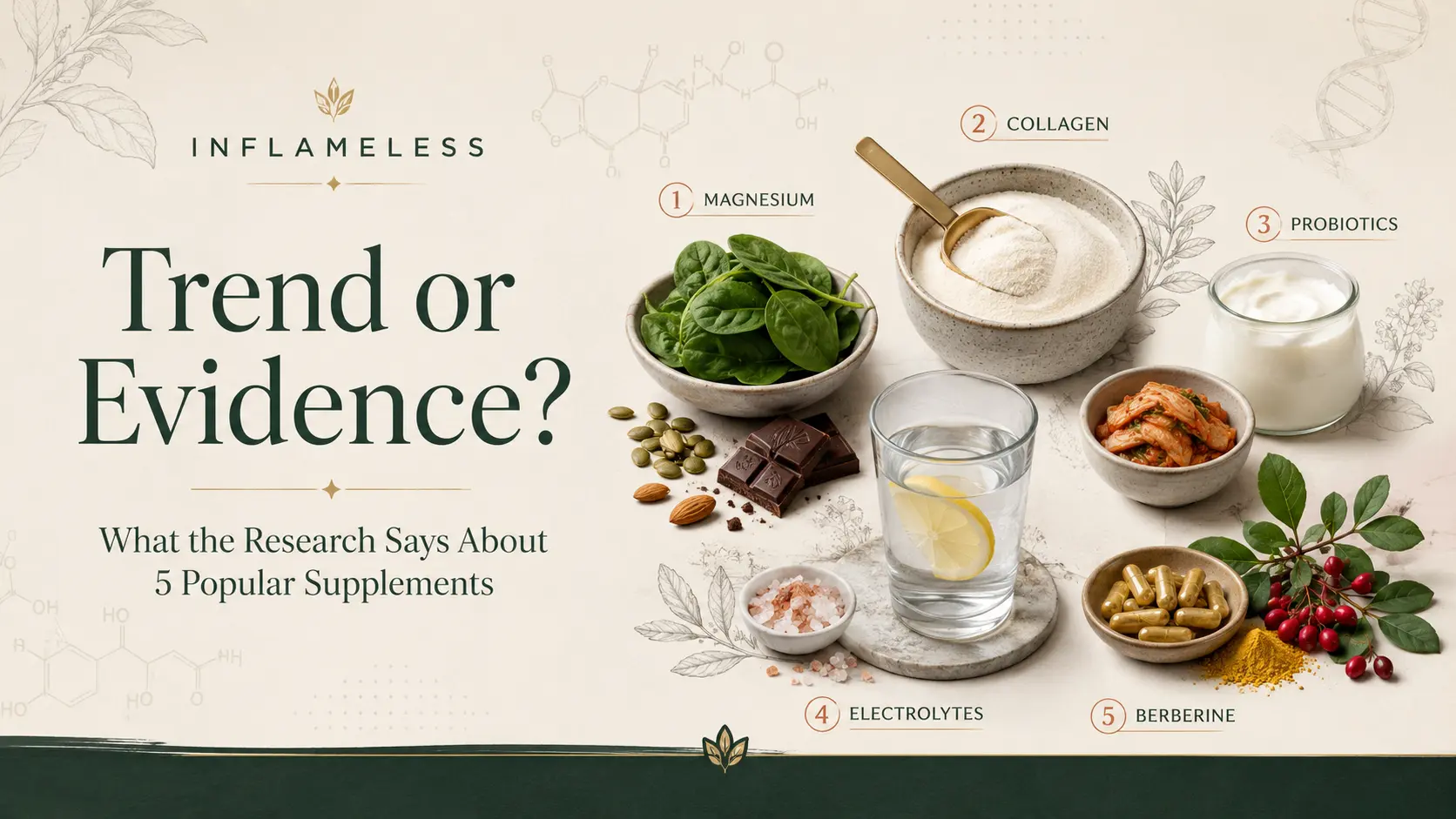
Your Instagram feed, your Pinterest board and your pharmacy checkout line all agree on one thing right now: you are apparently deficient in something, and there is a powder for that. Five supplements keep surfacing in the anti-inflammatory conversation - magnesium, collagen, probiotics, electrolytes and berberine. Some of them have genuine clinical backing. Some are riding a wave of survivorship bias and good marketing. Let's separate the two, one enzyme pathway at a time.
Magnesium: Trend, Backed by a Real (Small) Signal
Magnesium is magnesium's own worst spokesperson - it's involved in over 300 enzymatic reactions, which makes it an easy target for "magnesium fixes everything" claims. The actual clinical picture is more restrained than that, but it isn't nothing.
A 2025 randomized, placebo-controlled trial of 155 adults with poor sleep found that 250 mg of magnesium bisglycinate daily produced a measurable drop in Insomnia Severity Index scores over placebo - though placebo accounted for a substantial share of the total improvement, and the effect size in the best-designed trial was small. A separate systematic review of interventional trials found five of eight sleep studies and five of seven anxiety studies reported improvements, but flagged small sample sizes, inconsistent dosing and heterogeneity as real limitations. On the mood side, a meta-analysis of seven RCTs found a statistically significant reduction in depression scores with magnesium supplementation versus placebo.
Mechanistically, magnesium regulates the hypothalamic-pituitary-adrenal (HPA) axis - the same stress-signaling circuit that governs cortisol output - and magnesium depletion in animal models upregulates that axis in ways that look a lot like a chronically activated stress response. That's a plausible reason it shows up in sleep and anxiety research at all.
Verdict: Evidence-supported, "nice to have" effect. This is not a sedative. It's a cofactor that may take the edge off a dysregulated stress-sleep loop, particularly if your baseline intake is low. Worth a trial run. Not worth the £60 "calm magic" glycinate blend with twelve other ingredients you can't pronounce.
Collagen: Trend That Actually Has Receipts
Collagen supplements get lumped in with "wellness girl" marketing, which is a shame, because the RCT data here is some of the more consistent evidence on this list.
A 2025 meta-analysis of 23 randomized controlled trials covering 1,474 participants found that collagen supplementation significantly improved skin hydration, elasticity and wrinkle depth compared to placebo. A broader umbrella review of meta-analyses (searched through March 2025) confirmed those skin findings and additionally found high-certainty evidence for improvements in osteoarthritis-related pain and stiffness scores, with meta-regression showing longer intervention durations associated with better joint outcomes.
Mechanistically, oral collagen peptides appear to stimulate fibroblast activity in skin and inhibit inflammatory cartilage degradation in joints, likely by supplying amino acid substrates (glycine, proline, hydroxyproline) that support extracellular matrix synthesis.
Where the evidence goes soft: exercise recovery and body composition. The same umbrella review found little support for collagen as an ergogenic aid, with most studies showing no meaningful effect on muscle protein synthesis or athletic performance versus other protein sources. If your collagen tub promises "lean muscle support," that's the marketing department talking, not the RCTs.
Verdict: Evidence-supported for skin and joints, unsupported for muscle and performance. Certainty ranges from moderate to low across outcomes, and funding source does appear to influence some skin trial results - so buy from where the data is, not from where the discount code is.
Probiotics: Trend Wildly Outpacing the (Strain-Specific) Evidence
This is the one where marketing has lapped the science by several laps, to say it like this. "Probiotics" as a category claim is close to meaningless - the clinical benefit lives or dies at the level of specific strain, dose and condition, not the word "probiotic" on a label.
A 2026 strain-specific systematic review of 32 RCTs across 10 probiotic strains for IBS found that only a small subset - Lactobacillus plantarum 299v, Bacillus coagulans MTCC 5260 and Saccharomyces boulardii CNCM I 745 - showed reproducible, meta-analytically supported effects. Meanwhile, a systematic review of healthy adults found limited to no capacity for probiotics to meaningfully alter gut microbiota composition at all in most trials studied. That second finding matters: a lot of probiotic marketing implies you're "repopulating" your gut. The research mostly doesn't back that framing for healthy people.
Mechanistically, where effects are seen, they tend to work through modulation of short-chain fatty acid production, epithelial barrier integrity and mucosal immune signaling, but those same pathways are also powerfully influenced by diet, which most probiotic trials fail to control for, muddying causal attribution.
Verdict: Trend outrunning evidence, with real exceptions. If you have a diagnosed condition (IBS, atopic dermatitis, post-antibiotic disruption), specific strains have specific, testable evidence behind them. If you're a healthy adult taking a multi-strain blend "for gut health" in the abstract, you're likely paying for a very expensive placebo with good marketing copy and probably fine bacteria.
Electrolytes: Trend For Everyone, Evidence For Some People
Electrolyte sales have more than doubled since 2020, driven largely by influencer content implying that plain water is somehow insufficient for modern life. For most people eating a normal diet, it is not.
The consistent finding across sports medicine research: electrolyte supplementation becomes physiologically relevant once exercise exceeds roughly 60-90 minutes, particularly in heat, or with heavy, prolonged sweat losses. Below that threshold, water performs the job electrolyte drinks are marketed for. One head-to-head study even found that endurance athletes using electrolyte supplements were not meaningfully protected against exercise-associated sodium imbalances compared to those who managed hydration through thirst and appropriate fluid intake.
Mechanistically, sweat sodium losses can range widely between individuals (roughly 200-1,500 mg per liter), which is why blanket daily recommendations don't hold up - your actual need depends on your sweat rate, climate, and diet, not a universal serving size on a stick-pack.
Verdict: Legitimately useful for a specific population - endurance exercisers, heavy outdoor sweaters, ketogenic dieters cutting carbs (and therefore sodium) sharply, and people with GI losses. Largely unnecessary as a daily habit for someone doing a 30-minute walk and a desk job. Your kidneys have this covered.
Berberine: The Trend That's Actually Underselling Itself
Berberine went viral as "nature's Ozempic," which is both an overstatement and, oddly, an understatement of what the actual research supports for a different metabolic target.
A 2025 meta-analysis of randomized placebo-controlled trials found berberine significantly reduced fasting plasma glucose, 2-hour oral glucose tolerance, triglycerides, LDL cholesterol, total cholesterol, waist circumference, and BMI - though it had no significant effect on blood pressure or HDL cholesterol. The glucose-lowering effect in some trials has been compared favorably to metformin, which is an unusually strong claim for a plant alkaloid.
Mechanistically, berberine activates AMP-activated protein kinase (AMPK), a cellular energy sensor that increases insulin sensitivity, slows hepatic glucose production, and reduces cholesterol synthesis - functioning through a genuinely well-characterized pathway rather than a vague "detox" narrative .
Verdict: Evidence-supported for glycemic and lipid markers in people with metabolic dysregulation, and one of the more mechanistically well-documented compounds on this list. The caveats: GI side effects are common, it interacts with CYP-enzyme-metabolized medications, and "nature's Ozempic" oversells its weight-loss effect while underselling how solid the glucose and lipid data actually are. Talk to your prescriber before combining it with anything else touching blood sugar.
The Pattern Across All Five
Notice what separates the well-supported claims from the weak ones: specificity. "Magnesium helps sleep" is vague and modestly true. "Magnesium bisglycinate, 250 mg, in people with low baseline levels and disrupted HPA-axis signaling" is precise and better supported. The same goes for probiotics - "gut health" is not a testable outcome; "Lactobacillus plantarum 299v for IBS symptom severity" is. Evidence rewards precision. Marketing rewards vagueness. Read labels accordingly and always ask your health practictioner first.
References
- Schuster, J., Cycelskij, I., Lopresti, A., & Hahn, A. (2025). Magnesium bisglycinate supplementation in healthy adults reporting poor sleep: A randomized, placebo-controlled trial. Nature and Science of Sleep, 17, 2027-2040.
- Winkler, A., & Rief, W. (2015). Effect of placebo conditions on polysomnographic parameters in primary insomnia: A meta-analysis. Sleep, 38(6), 925-931.
- Rawji, A., Peltier, M. R., Mourtzanakis, K., Awan, S., Rana, J., Pothen, N. J., & Afzal, S. (2024). Examining the effects of supplemental magnesium on self-reported anxiety and sleep quality: A systematic review. Cureus, 16(4), e59317.
- Moabedi, M., Aliakbari, M., Erfanian, S., & Milajerdi, A. (2023). Magnesium supplementation beneficially affects depression in adults with depressive disorder: A systematic review and meta-analysis of randomized clinical trials. Frontiers in Psychiatry, 14.
- Effects of Collagen Supplements on Skin Aging: A Systematic Review and Meta-Analysis of Randomized Controlled Trials. (2025). The American Journal of Medicine.
- Danessa, G., Notario, D., & Regina, R. (2025). Effects of collagen-based supplements on skin's hydration and elasticity during ageing: A systematic review and meta-analysis. Indian Journal of Dermatology, Venereology and Leprology, 91, 730-740.
- Collagen Supplementation for Skin and Musculoskeletal Health: An Umbrella Review of Meta-Analyses on Elasticity, Hydration, and Structural Outcomes. (2026). Aesthetic Surgery Journal Open Forum.
- Morawiecka, N., Rosa-Bończak, M., Marta, P. K., et al. (2025). The role of collagen supplementation in improving skin quality and joint function: Mechanisms of action, effectiveness, and future research directions. Journal of Education, Health and Sport, 80.
- Maslennikov, R., Gosteeva, E., Ananeva, V., et al. (2026). Strain-specific systematic review with meta-analysis of probiotics efficacy in the treatment of irritable bowel syndrome. Journal of Clinical Medicine, 15(3), 1152.
- Cosier, D. J., Lambert, K., Neale, E. P., Probst, Y., & Charlton, K. (2025). The effect of oral synbiotics on the gut microbiota and inflammatory biomarkers in healthy adults: A systematic review and meta-analysis. Nutrition Reviews, 83(2), e4-e24.
- Probiotics in irritable bowel syndrome: Strain-specific effects, diet, and biomarker timing. (2026). Frontiers in Cellular and Infection Microbiology.
- Axios. (2023). No, you don't need daily electrolyte supplements.
- American Heart Association. (2024). Electrolytes can give the body a charge, but try not to overdo it.
- Montain, S. J. (2000). Fluid and electrolyte supplementation for exercise heat stress. PubMed, US Army Research Institute of Environmental Medicine.
- Stanford University School of Medicine. (2020). Electrolyte supplements don't prevent illness in athletes.
- Transparent Labs. (2026). Are electrolytes safe to take every day?
- Efficacy and safety of berberine on the components of metabolic syndrome: A systematic review and meta-analysis of randomized placebo-controlled trials. (2025). PubMed.
- Berberine: A rising star in the management of type 2 diabetes - Novel insights into its anti-inflammatory, metabolic, and epigenetic mechanisms. (2025). PMC.
- Modulation of gut microbiota and metabolites by berberine in treating mice with disturbances in glucose and lipid metabolism. PMC.
Medical Disclaimer: This article is intended for educational purposes only and does not constitute medical advice, diagnosis, or treatment. Supplement research, including the studies cited above, often involves small sample sizes, short durations, and specific populations that may not generalize to your individual circumstances. Berberine and magnesium in particular can interact with prescription medications, including those for diabetes, blood pressure, and other conditions. Always consult a qualified healthcare provider before starting, stopping, or combining any supplement, especially if you are pregnant, breastfeeding, managing a chronic condition, or taking medication.