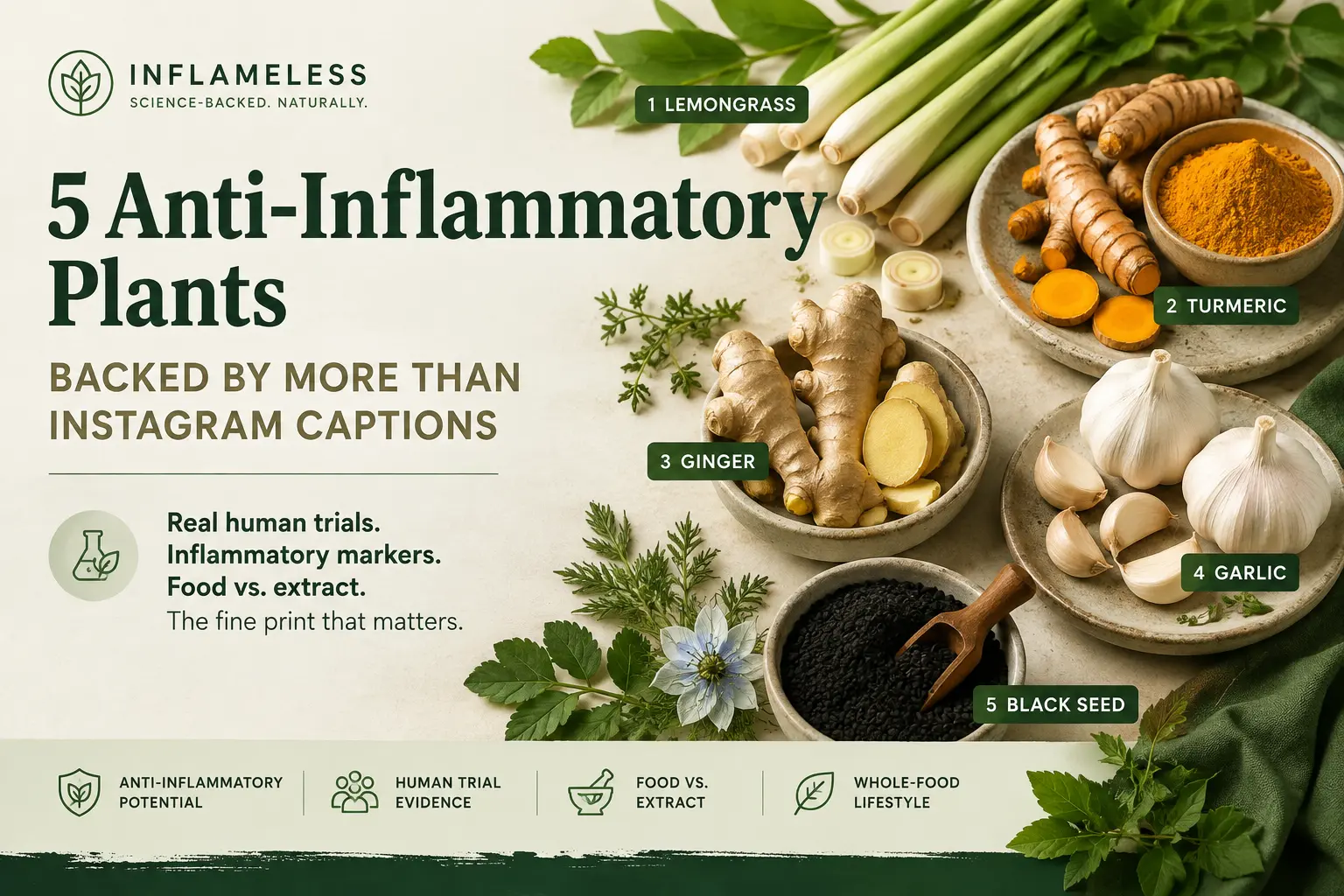
Every wellness feed has a version of this list. Turmeric golden milk, ginger shots, garlic-as-medicine memes. What most of those posts skip is the fine print - the difference between "contains a compound that reduces inflammatory markers in a lab" and "will fix your joint pain by Tuesday."
This is that fine print, minus the sanctimony.
Below are five plants with real human trial data behind their anti-inflammatory reputation, ranked not by popularity but by how interesting the evidence actually is once you read past the abstract. For each one, I'm separating two very different things people conflate constantly: eating the plant as food, and taking the concentrated extract or supplement used in the actual research. Those are not interchangeable and treating them as such is how health claims get inflated.
A quick vocabulary note before we start: most of these studies measure "inflammatory markers" - blood proteins like CRP (C-reactive protein), TNF-alpha and IL-6 that rise when the body is fighting inflammation. A supplement lowering these markers on a lab report is not the same as a supplement resolving your knee pain. It's upstream evidence, not a clinical endpoint. Worth remembering as you read.
1. Lemongrass (Cymbopogon citratus / flexuosus)
Key compound: Citral (a mix of geranial and neral)
Lemongrass is the outlier on this list - not because the mechanism is weak, but because the human clinical evidence is thin compared to the other four. Its case rests mostly on cell studies and a handful of small human trials, not large meta-analyses.
What's solid: citral has demonstrated real anti-inflammatory activity in human dermal fibroblasts. A 2017 study found lemongrass essential oil significantly suppressed inflammatory biomarkers - VCAM-1, IP-10, I-TAC, and MIG - in pre-inflamed human skin cells, along with tissue-remodeling markers like collagen-I and III. That's the first real evidence this plant does something biologically meaningful in human tissue, not just in a petri dish of bacteria.
Beyond that, the picture thins out fast. A 2022 scoping review searching three major databases for clinical trials on lemongrass essential oil found only 8 qualifying studies in nearly a decade, and most of those concerned oral or topical skin use - not systemic inflammation or joint pain. In people with rheumatoid arthritis, one 2017 study reported that topical lemongrass oil reduced self-reported pain scores by roughly half over 30 days, but this is one small trial, not a replicated finding.
There is currently no clinical trial testing lemongrass oil on an acute injury like a sprain. If you see that claim anywhere, it's an extrapolation, not a citation.
Food vs. extract: A cup of lemongrass tea and a bottle of essential oil are not delivering comparable citral doses - the oil is orders of magnitude more concentrated and it's also known to irritate skin when applied undiluted.
2. Turmeric (Curcuma longa)
Key compound: Curcumin
Turmeric is the anchor of this list because it has the deepest research base - and, refreshingly, the research doesn't universally agree with itself, which is a sign you're looking at real science rather than marketing copy.
On the positive side: an umbrella meta-analysis pooling 10 studies and nearly 5,900 participants found curcumin supplementation significantly reduced CRP, IL-6 and TNF-alpha, with larger effects in older participants and bigger trials. A separate dose-response meta-analysis reported similar reductions in CRP, TNF-alpha and IL-6, plus improved antioxidant markers. A broader review of 54 meta-analyses found CRP reductions in 7 out of 10 pooled analyses and TNF-alpha reductions in 6 out of 9.
On the more sober side: a 2019 systematic review of 19 RCTs covering rheumatic disease, kidney disease, and metabolic syndrome found turmeric or curcumin did not significantly lower CRP, hs-CRP, IL-1beta, IL-6, or TNF-alpha compared to placebo. And a 2025 meta-analysis focused specifically on rheumatoid arthritis and lupus patients found no significant effect on disease activity scores, ESR or CRP.
The honest summary: curcumin's anti-inflammatory signal is real and mechanistically plausible, but it's inconsistent across populations, doses and formulations - and the "7 of 10" and "not significant" findings above are pulling from overlapping literature. This is not a settled question.
Food vs. extract: Curry powder turmeric and the curcuminoid doses used in these trials (often 500-2000 mg/day of standardized extract, frequently paired with piperine or a lipid carrier for absorption) are not the same exposure. Curcumin is poorly absorbed on its own - formulation is doing a lot of the work in the positive trials.
3. Ginger (Zingiber officinale)
Key compounds: Gingerols and shogaols
Ginger has one of the more consistent inflammatory-marker profiles on this list, which is somewhat surprising given how casually it gets used in everyday cooking.
A 2020 meta-analysis of 16 RCTs and just over 1,000 participants found ginger supplementation significantly reduced CRP, hs-CRP, and TNF-alpha, though it had no measurable effect on IL-6 or sICAM. A separate 2020 meta-analysis pooling 25 studies reported statistically significant reductions across CRP, TNF-alpha, IL-6, and oxidative stress markers (TAC and MDA). An earlier, smaller meta-analysis of 9 studies found a more modest but still significant CRP reduction.
The caveat that shows up in nearly every one of these papers, almost word for word: heterogeneity is high. Study populations range from healthy adults to people with type 2 diabetes to people with fatty liver disease, and dosing protocols vary widely. That's not a reason to dismiss the findings, but it does mean "ginger lowers CRP" is a population-level average, not a guarantee for any one person's bloodwork.
Food vs. extract: Most trials used powdered ginger root capsules (1-3 g/day) for weeks to months - well beyond what you'd get from a knob of fresh ginger in a stir-fry, though fresh ginger contributes to the same compound pool at lower concentrations.
4. Garlic (Allium sativum)
Key compounds: Allicin and other organosulfur compounds
Garlic's evidence base is large, consistent in direction, and modest in magnitude - a combination that's actually more trustworthy than a smaller study reporting a dramatic effect.
A 2019 meta-analysis of 16 RCTs found garlic supplementation significantly reduced CRP, IL-6 and TNF, though it had no measurable effect on adiponectin or leptin. A separate 2020 meta-analysis of 17 RCTs confirmed the CRP reduction and found that aged garlic extract specifically was effective for lowering TNF-alpha, while plain garlic supplementation didn't move IL-6. A third meta-analysis focusing on shorter trials found TNF-alpha and CRP reductions were more likely to reach significance in studies lasting longer than 6-8 weeks, suggesting a duration threshold matters.
Worth noting: the reductions reported are real but small in absolute terms - about 0.6 mg/L for CRP in the largest analysis, which is a meaningful shift at a population level but not something you'd feel.
Food vs. extract: This is the plant where the food-vs-extract distinction matters most mechanically. Allicin is only generated when garlic is crushed or chopped, via an enzymatic reaction, and it's unstable - it degrades with heat and time. The aged garlic extract used in several of the strongest trials undergoes a completely different processing method than a clove tossed into a hot pan.
5. Black Seed / Nigella sativa
Key compound: Thymoquinone
Black seed is the least social media-saturated plant on this list and also one of the more consistently positive in the inflammatory-marker literature - though "consistently positive" comes with real caveats about effect size and study quality.
The largest and most recent meta-analysis (20 RCTs, 1,086 participants) found significant reductions in CRP, TNF-alpha and MDA, alongside improvements in total antioxidant capacity and glutathione peroxidase. A separate 2021 meta-analysis of 10 trials found similar reductions in hs-CRP, TNF-alpha and MDA. A third, smaller meta-analysis of 12 trials found CRP and MDA reductions but, notably, no significant effect on TNF-alpha - a discrepancy with the larger analyses above that hasn't been fully resolved.
An earlier and more narrowly scoped meta-analysis of just 5 trials found black seed improved one antioxidant marker (SOD) but had no effect on MDA or total antioxidant capacity - a reminder that pooled results shift substantially depending on which studies get included, and that "meta-analysis says X" is only as good as the trials feeding it.
Food vs. extract: Nigella sativa research almost universally uses seed oil or powdered seed in capsule form at specified doses (commonly 1-3 g/day or 1-3 mL/day of oil) - sprinkling the seeds on bread, while traditional in many cuisines, is not replicating trial conditions.
The pattern across all five
If there's a throughline here, it's this: every plant on this list has some legitimate human evidence for lowering inflammatory blood markers and none of them has evidence strong enough to call it a treatment for a specific condition. Turmeric's evidence is the most contested, ginger and garlic are the most consistent, black seed is the most underrated and lemongrass is the one riding furthest ahead of its data.
None of that makes them useless. Mechanism-plausible, marker-supported, dose-dependent, food-culture-compatible plants are exactly the kind of low-risk additions worth having in a kitchen. Include them in your daily recipes. It just means the claims on the label should match the claims in the literature - and most wellness content doesn't bother checking.
References
- Han, X., & Parker, T. L. (2017). Lemongrass (Cymbopogon flexuosus) essential oil demonstrated anti-inflammatory effect in pre-inflamed human dermal fibroblasts. Biochimie Open. https://www.ncbi.nlm.nih.gov/pmc/articles/PMC5801909/
- Exploring the Clinical Applications of Lemongrass Essential Oil: A Scoping Review. (2023). PMC. https://pmc.ncbi.nlm.nih.gov/articles/PMC10892616/
- Potential Uses of Lemongrass Oil. Healthline. https://www.healthline.com/health/lemongrass-essential-oil
- Profiling Inflammatory Biomarkers following Curcumin Supplementation: An Umbrella Meta-Analysis of Randomized Clinical Trials. PMC. https://pmc.ncbi.nlm.nih.gov/articles/PMC9870680/
- Antioxidant and anti-inflammatory effects of curcumin/turmeric supplementation in adults: A GRADE-assessed systematic review and dose-response meta-analysis of randomized controlled trials. PubMed. https://pubmed.ncbi.nlm.nih.gov/36804260/
- Is Curcumin Intake Really Effective for Chronic Inflammatory Metabolic Disease? A Review of Meta-Analyses of Randomized Controlled Trials. PMC. https://www.ncbi.nlm.nih.gov/pmc/articles/PMC11174746/
- Oral turmeric/curcumin effects on inflammatory markers in chronic inflammatory diseases: A systematic review and meta-analysis of randomized controlled trials. PubMed. https://pubmed.ncbi.nlm.nih.gov/31121255/
- Effects of curcumin and Curcuma longa extract on inflammatory biomarkers in patients with rheumatoid arthritis (RA) and systemic lupus erythematosus (SLE): a systematic review and meta-analysis of randomized controlled trials. PMC. https://pmc.ncbi.nlm.nih.gov/articles/PMC12696035/
- Morvaridzadeh, M., et al. (2020). Effect of ginger (Zingiber officinale) on inflammatory markers: A systematic review and meta-analysis of randomized controlled trials. PubMed. https://pubmed.ncbi.nlm.nih.gov/32763761/
- The effects of ginger supplementation on markers of inflammatory and oxidative stress: A systematic review and meta-analysis of clinical trials. Wiley Online Library. https://onlinelibrary.wiley.com/doi/abs/10.1002/ptr.6638
- The effect of ginger supplementation on serum C-reactive protein, lipid profile and glycaemia: a systematic review and meta-analysis. PMC. https://www.ncbi.nlm.nih.gov/pmc/articles/PMC5093315/
- Garlic Supplementation Reduces Circulating C-reactive Protein, Tumor Necrosis Factor, and Interleukin-6 in Adults: A Systematic Review and Meta-analysis of Randomized Controlled Trials. The Journal of Nutrition. https://academic.oup.com/jn/article/149/4/605/5428122
- Effects of garlic supplementation on serum inflammatory markers: A systematic review and meta-analysis of randomized controlled trials. PubMed. https://pubmed.ncbi.nlm.nih.gov/32673835/
- Effect of garlic intake on inflammatory mediators: a systematic review and meta-analysis of randomised controlled trials. PubMed. https://pubmed.ncbi.nlm.nih.gov/32051282/
- The effect of Nigella sativa (black seed) on biomarkers of inflammation and oxidative stress: an updated systematic review and meta-analysis of randomized controlled trials. Inflammopharmacology / PubMed. https://pubmed.ncbi.nlm.nih.gov/37036558/
- The effect of nigella sativa on biomarkers of inflammation and oxidative stress: A systematic review and meta-analysis of randomized controlled trials. PubMed. https://pubmed.ncbi.nlm.nih.gov/33559935/
- Effect of Nigella sativa L. supplementation on inflammatory and oxidative stress indicators: A systematic review and meta-analysis of controlled clinical trials. PubMed. https://pubmed.ncbi.nlm.nih.gov/33183658/
- Effect of Nigella sativa Supplementation on Oxidative Stress and Antioxidant Parameters: A Meta-Analysis of Randomized Controlled Trials. PMC. https://www.ncbi.nlm.nih.gov/pmc/articles/PMC7225850/
Medical Disclaimer: This article is for educational and informational purposes only and does not constitute medical advice, diagnosis, or treatment. The information presented reflects a summary of published research on inflammatory biomarkers and is not a substitute for consultation with a qualified healthcare provider. Herbal supplements and essential oils can interact with medications, affect bleeding risk, and are not appropriate for everyone, including pregnant or breastfeeding individuals and those with certain medical conditions. Always consult a licensed healthcare professional before starting any new supplement, especially if you have an existing health condition or take prescription medication.
Glossary
Quick reference for the acronyms used throughout this article:
- CRP - C-reactive protein. A blood protein that rises during inflammation; the most commonly measured marker in these studies.
- hs-CRP - High-sensitivity CRP. A more precise version of the CRP test, able to detect lower-grade inflammation.
- TNF-alpha - Tumor necrosis factor alpha. A signaling protein (cytokine) that triggers and amplifies inflammation.
- IL-6 - Interleukin-6. A cytokine involved in triggering the liver to produce CRP; a key driver of the inflammatory response.
- IL-1beta - Interleukin-1 beta. Another inflammatory cytokine, active in the early stages of the inflammatory response.
- sICAM - Soluble intercellular adhesion molecule. A marker linked to blood vessel inflammation and immune cell movement.
- MDA - Malondialdehyde. A byproduct of oxidative stress; higher levels indicate more cellular damage from free radicals.
- TAC - Total antioxidant capacity. A measure of the body's overall ability to neutralize oxidative stress.
- SOD - Superoxide dismutase. An antioxidant enzyme that helps protect cells from oxidative damage.
- GPx - Glutathione peroxidase. Another antioxidant enzyme that helps break down harmful peroxides in cells.
- ESR - Erythrocyte sedimentation rate. An older, less specific marker of inflammation, often used alongside CRP.
- RCT - Randomized controlled trial. A study design where participants are randomly assigned to a treatment or placebo group, considered the gold standard for testing whether an intervention actually works.
- SMD / WMD - Standardized/weighted mean difference. Statistical measures used in meta-analyses to combine results from multiple studies into one overall effect size.
- CI (95%) - Confidence interval. The range in which the true effect likely falls; if this range crosses zero, the result isn't considered statistically significant.