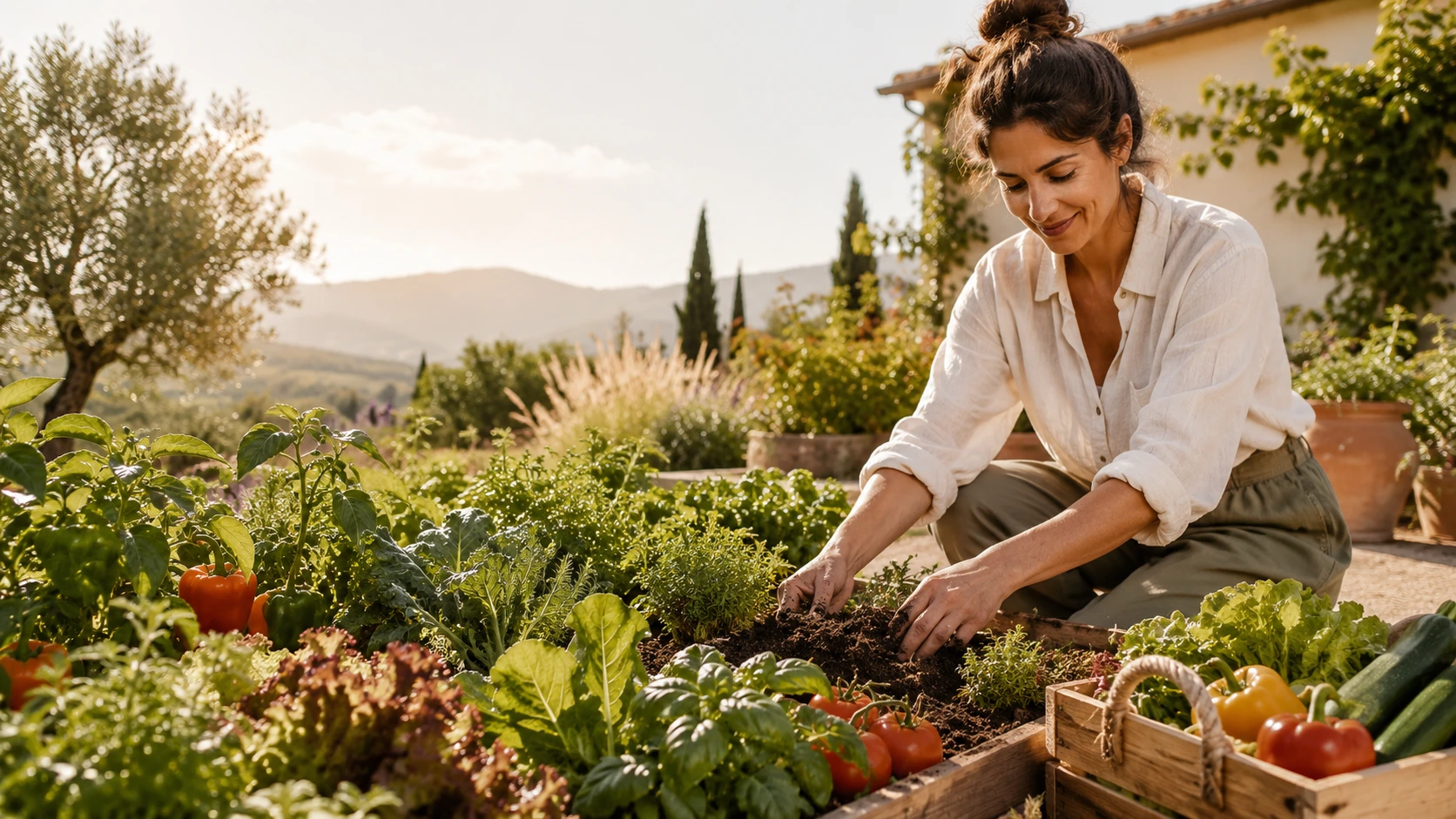
Nobody hands you a wheelbarrow and calls it an intervention. That's precisely why gardening tends to work when the intervention you were prescribed didn't.
Here's the mechanism problem with most health advice: it asks you to add one more discrete task to a day that's already full. Sounds familiar? Ten more minutes of "mindfulness," one more supplement, one more app reminding you to breathe. Gardening doesn't ask you but it bundles movement, daylight, attention regulation and food access into a single activity that has its own reason for existing - the tomatoes need water whether or not you feel like optimizing your cortisol today.
I keep a food forest, so I'm not approaching this one from a research abstract. But the goal here isn't to romanticize dirt under your fingernails - it's to separate what gardening actually does to your physiology from what Pinterest wants it to do.
A 2024 umbrella review pulling together 40 prior reviews found a consistent positive association between gardening and measures of well-being, quality of life, and general health outcomes - though the underlying studies varied enough that this reads as supportive lifestyle practice, not clinical intervention. Worth holding onto that distinction, because the rest of this article is going to keep circling back to it.
1. It's resistance training that doesn't know it's resistance training
Digging, hauling soil, wrestling a wheelbarrow uphill, standing back up from a crouch forty times an afternoon - none of this reads as "workout" in your head, which is exactly why you keep doing it.
Researchers measuring the metabolic cost of common gardening tasks have classified light watering as barely above resting, while digging and turning soil land in moderate-to-vigorous territory depending on the person and the task. That range matters more than it sounds - it means a single gardening session can include both recovery-pace movement and genuine cardiovascular load, without you ever having to decide which one you're "supposed" to be doing.
Current activity guidelines put the weekly target at 150 minutes of moderate activity plus strength work on two or more days. Gardening won't replace progressive resistance training if that's what your joints and muscle mass actually need. What it does is make movement repeatable, because the payoff isn't "I exercised" - it's "the bed is weeded." Different reward circuit, same muscle contraction.
2. Morning light in the garden is doing something your alarm clock can't
Vitamin D gets all the attention when we talk about sunlight, but the more interesting mechanism is circadian, not nutritional.
Light hitting the retina - not the skin - is the primary signal your suprachiasmatic nucleus uses to anchor the day-night rhythm that governs melatonin release, cortisol timing, and downstream sleep architecture. Outdoor daytime light exposure has been associated with more favorable sleep and mood outcomes, and the effect appears strongest earlier in the day.
This is why ten minutes checking on herbs at 8am is not biologically interchangeable with ten minutes on your phone in a dim kitchen, even though both technically count as "ten minutes of your morning." You don't need direct sun for this. Partial shade still delivers a strong enough light signal to matter - the circadian benefit doesn't require a sunburn to collect.
3. Vitamin D synthesis happens, but there's no universal "right amount"
Gardening puts you outside, and UVB exposure lets your skin manufacture vitamin D. That part is straightforward biochemistry.
What isn't straightforward is turning that into a number. Vitamin D production from sun exposure shifts with season, latitude, skin pigmentation, age, how much skin is exposed, cloud cover, and your existing vitamin D status - which is a long way of saying that "just get 15 minutes of sun" is a rule of thumb, not a prescription. The WHO's position is that small amounts of UV exposure support vitamin D synthesis, while excess exposure increases skin cancer and eye damage risk, with sun protection recommended once the UV index hits 3 or above.
Practically: garden earlier or later in the day, use shade and a hat when the sun is high, and treat sunscreen as compatible with - not opposed to - getting outside regularly. The target is consistent outdoor time, not maximum UV collection.
4. The attention gardening demands is active, but not urgent - and that distinction matters
Checking soil moisture, spotting new growth, pulling one weed at a time: this is attention with a job to do, but no alarm attached to it. That's a different nervous system state than the one most of your day runs on, where every input arrives tagged "respond now."
A randomized controlled trial of nearly 300 adults assigned to begin community gardening found increases in fiber intake and moderate-to-vigorous activity alongside measurable reductions in perceived stress and anxiety. That's a meaningfully stronger design than comparing people who already like gardening to people who don't - it tells you the activity itself is doing something, not just selecting for people who were already less stressed.
The likely mechanism isn't one variable - it's the same stack showing up again: movement, light, greenery, repetitive physical tasks, a visible result, and time away from a screen that doesn't stop generating inputs.
5. The soil bacteria claim - where it's real and where it gets stretched
This is the part where gardening content usually goes off the rails, so let's be precise about it.
Mycobacterium vaccae is a bacterium found in soil and water. Research on heat-killed preparations of specific strains has shown genuinely interesting effects: in mice, treatment reduced stress-related inflammatory changes and offered some protection against certain behavioral effects of chronic stress. Other lab work has traced effects on immune cell signaling and inflammatory pathways.
What these studies did not do is expose humans to garden soil and measure a mood or inflammation response. They used controlled, concentrated preparations administered to animals or cells - not a handful of compost. Calling M. vaccae a "natural antidepressant" you absorb by gardening without gloves is a claim the current evidence doesn't support.
The more honest version: contact with a microbially diverse environment may be one piece of a healthier relationship between immune system, nervous system, and the microbial world we evolved inside of. M. vaccae is a promising research model. It is not, on its own, the explanation for why gardening makes you feel better - and you don't need to skip gloves or inhale soil dust to get the rest of the benefits.
6. Growing food changes what you eat, not just what you know
Knowing broccoli is good for you has never reliably resulted in more broccoli being eaten. Availability does that. So does the faint sense of obligation that shows up when you've personally kept a plant alive for six weeks and it would be a shame to let the harvest rot.
A randomized trial of community gardeners found vegetable intake increased by roughly 0.63 servings during the growing season - an effect that faded in winter, which tells you something useful: gardening supports the eating pattern, but continued access still does the heavy lifting. The WHO recommends at least 400g of fruit and vegetables daily for most adults as part of a baseline healthy pattern. One homegrown cucumber isn't detoxifying anything - what it's doing is lowering the friction between "I know this is good for me" and "I actually ate it."
7. Homegrown and organic aren't automatically more nutritious - just more controlled
Growing your own gives you control over inputs: compost instead of synthetic fertilizer, crop rotation and physical barriers instead of broad-spectrum pesticide as a default. That can reduce residue exposure depending on how the garden is actually managed.
It does not automatically mean more nutrients though. A major systematic review found organic produce less likely to carry detectable pesticide residue, but did not find consistent, substantial nutritional superiority over conventionally grown food. The real advantages of growing your own are more modest and more honest: freshness, variety you can't buy, seasonal eating, less packaging, and - see point six - a much stronger reason to actually eat it. A conventionally grown vegetable you eat still beats an organic one left in the crisper drawer.
Where this fits into the bigger picture
None of this replaces medical care, structured training or treatment for a diagnosed condition. What gardening offers is something most single-variable interventions can't: it stacks movement, circadian light exposure, attention regulation, and food access into one recurring behavior that doesn't need willpower to repeat, because the plant's needs are doing the reminding.
You move because the bed needs turning. You go outside because something needs water. You slow down because growth has its own timeline and does not care about yours. You eat the harvest because you were there when it grew.
That's not a wellness routine but it gets as close as grounding as you need. That's just what tending something does to a person, and it happens to line up with several mechanisms worth caring about.
A few practical notes before you start
Soil is biologically active, which is the whole point - but not everything living in it is neutral. Wear gloves if you have open cuts, wash your hands after gardening even if you worked with gloves on, and rinse produce before eating. If you're pregnant, take extra care around soil that stray cats may have used, due to toxoplasmosis risk. If you're significantly immunocompromised, ask your care team about precautions around compost, potting mix dust, and mold before diving in. If your garden sits near an older building, a busy road, or former industrial land, get the soil tested for lead - raised beds with verified clean soil are the safer default when you don't know the site's history.
You don't need acreage to start. One pot of basil on a sunny windowsill, a container of mint on a balcony, a shared plot in a community garden - the mechanisms above don't require a farm, just something alive that depends on you showing up.
Frequently asked questions
Does gardening count as exercise? Many gardening tasks qualify as light-to-moderate physical activity, with digging and soil-turning reaching moderate-to-vigorous intensity. It can contribute to weekly activity targets, though it likely won't fully replace dedicated cardiovascular and strength training.
Can gardening help with stress and anxiety? Trial evidence points to reductions in perceived stress and anxiety among people who take up gardening, most likely from the combination of movement, light, attention regulation, and a visible sense of progress rather than one single mechanism.
Does touching soil actually change my microbiome? Soil contact exposes skin and airways to environmental microbes, but there's currently no strong evidence that ordinary gardening produces lasting, clinically meaningful changes to the human gut or immune system.
Is Mycobacterium vaccae really a natural antidepressant? Animal and lab research on concentrated preparations suggests immune and stress-pathway effects, but that hasn't been shown to translate to mood benefits from casual soil exposure during gardening.
Is homegrown produce more nutritious than store-bought? It's typically fresher and tends to get eaten more consistently, but nutrient content still depends on variety, growing conditions, and how the produce is stored - not on the fact that you grew it yourself.
References
- Panțiru I, Ronaldson A, Sima N, Dregan A, Sima R. The impact of gardening on well-being, mental health, and quality of life: an umbrella review and meta-analysis. Systematic Reviews. 2024;13:45. DOI: 10.1186/s13643-024-02457-9
- Effects of common gardening tasks on metabolic intensity in older adults. PubMed. Available at: pubmed.ncbi.nlm.nih.gov/25515757
- Associations between daytime light exposure and sleep timing outcomes. PubMed. Available at: pubmed.ncbi.nlm.nih.gov/37812713
- Litt JS, et al. Effects of a community gardening intervention on diet, physical activity, and anthropometry outcomes in the USA: an observer-blind, randomised controlled trial. The Lancet Planetary Health. 2023;7:e23-e32. DOI: 10.1016/S2542-5196(22)00303-5
- Reber SO, et al. Immunization with a heat-killed preparation of the environmental bacterium Mycobacterium vaccae promotes stress resilience in mice. Proceedings of the National Academy of Sciences. 2016;113:E3130-E3139. DOI: 10.1073/pnas.1600324113
- Holbrook EM, et al. Mycobacterium vaccae NCTC 11659, a soil-derived bacterium with stress resilience properties, modulates the proinflammatory effects of LPS in macrophages. International Journal of Molecular Sciences. 2023;24:5176. DOI: 10.3390/ijms24065176
- Alaimo K, et al. Community gardening increases vegetable intake and seasonal eating from baseline to harvest. Current Developments in Nutrition. 2023;7:100077. DOI: 10.1016/j.cdnut.2023.100077
- Smith-Spangler C, et al. Are organic foods safer or healthier than conventional alternatives? A systematic review. Annals of Internal Medicine. 2012;157:348-366. DOI: 10.7326/0003-4819-157-5-201209040-00007
Medical disclaimer: This article is for general educational purposes and is not a substitute for personalized medical advice, diagnosis, or treatment. Gardening involves sun exposure, heat, physical strain, and contact with soil-borne organisms. If you are pregnant, immunocompromised, recovering from surgery, or managing a condition that affects mobility, immunity, skin integrity, or heat tolerance, speak with a qualified healthcare professional before increasing physical activity or soil exposure. Consult local guidance on soil testing and pesticide use for your specific site.