There is something strangely modern about being tired, inflamed, wired and disconnected all at once.
We spend most of the day indoors: shoes on, floors underneath our feet, screens everywhere, food available at every hour, lights all night long and stress on the couch. Our bodies are ancient, but the environment we ask them to live in is very new.
And when we talk about diabetes or insulin resistance, we usually talk about food first. We go straigh to carbohydrates, especially sugar, we talk blood glucose numbers and we tackle a little bit of exercise.
All of that matters.
But there is another question worth asking, carefully and without exaggeration:
What happens when the body is chronically disconnected from one of the simplest environmental signals it evolved with: the direct contact with the Earth?
This is where grounding, also called earthing, enters the conversation.
We are not talking about a miracle cure or a replacement for nutrition, movement, sleep or medical care.
But we talk possibly about one small signal that may help the body shift toward better regulation.
What grounding actually means
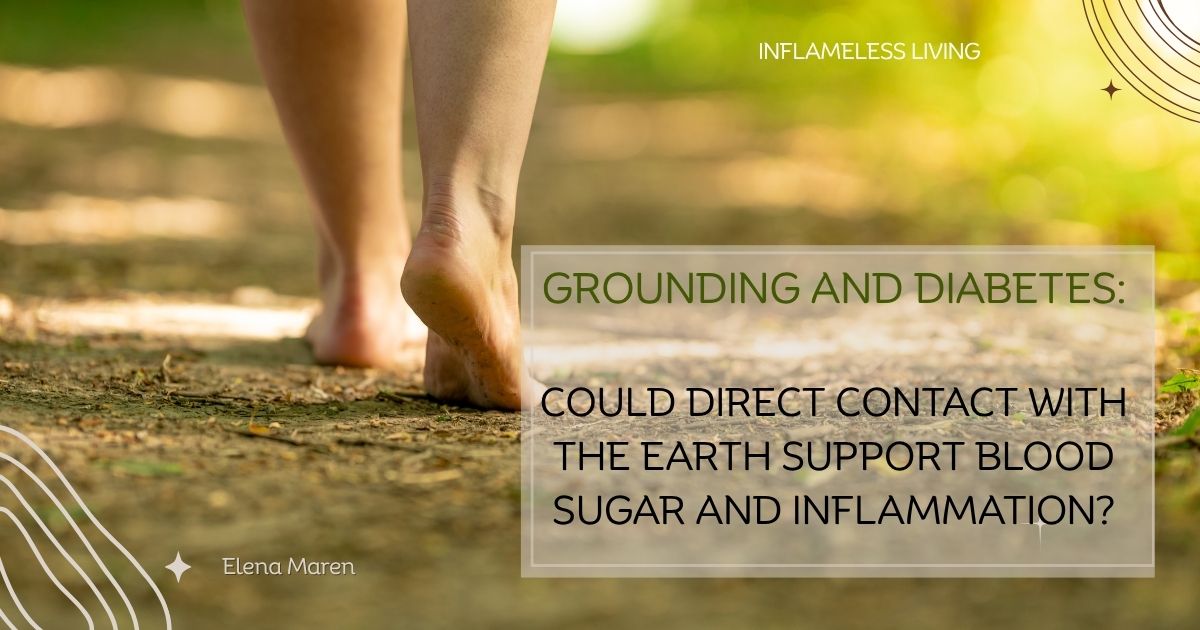
Grounding simply means placing the body in direct contact with the Earth’s surface.
Walking barefoot on grass, soil, sand or natural ground. Sitting outside with bare feet touching the earth. Swimming in the sea. In some studies, researchers also use conductive mats, sheets or patches connected to the ground, especially for people living on upper floor in the big cities.
The theory is that direct contact with the Earth allows the body to equalize electrically with the Earth’s surface. Some researchers propose that this may influence oxidative stress, inflammation, blood flow, autonomic nervous system activity and other physiological processes.
That sounds abstract, so let’s bring it back to metabolism.
Diabetes is not only a blood sugar condition. It is also deeply connected to inflammation, oxidative stress, blood vessel function, circulation, mitochondrial stress and insulin signalling.
When those systems are under pressure, glucose regulation becomes harder.
So the question is not, “Can grounding cure diabetes?”
The better question is:
Could grounding gently support some of the systems that are already involved in diabetes and chronic inflammation?
The honest answer is: maybe, but the evidence is still early.
The diabetes study people often mention
One of the most direct studies on grounding and diabetes was published in 2011 by Karol Sokal and Pawel Sokal in the Journal of Alternative and Complementary Medicine.
The researchers looked at several physiological effects of earthing the human body, including mineral balance, thyroid markers, immune response and glucose concentration.
One part of the study examined glucose concentration in people with diabetes. The authors reported that continuous earthing decreased blood glucose in patients with diabetes.
That sounds exciting.
But this is where we need to stay grounded in another way: scientifically.
The glucose experiment involved only 12 people. That is very small. It was not a large clinical trial. It does not prove that grounding treats diabetes. It does not tell us whether grounding lowers HbA1c over months, reduces medication needs safely, prevents complications or works consistently in different people.
It gives us a signal and signals are useful, but they are not the same as proof.
In the Inflameless approach, I would place grounding in the category of “interesting, low-risk lifestyle signal with early evidence. And also something deeply connected with our ancestral biology.
Why inflammation matters in diabetes
To understand why grounding might be relevant at all, we need to look at diabetes beyond glucose.
Type 2 diabetes and insulin resistance are strongly linked with chronic low-grade inflammation. This is not the kind of inflammation you see when you twist an ankle and it becomes red and swollen. Chronic inflammation is like background noise in the immune system.
Over time, this inflammatory background can affect insulin signalling, blood vessels, mitochondria, fat tissue, liver metabolism and recovery.
Oxidative stress also plays a role. When glucose and fatty acids are repeatedly elevated, mitochondria are pushed to process more fuel than they can comfortably handle. That can increase reactive oxygen species, which can then feed more inflammation.
This is one reason people with blood sugar problems often do not just feel “high glucose.”
They may feel tired, puffy, heavy, bloated, foggy... inflamed.
The symptoms can feel scattered, but they often share the same terrain: metabolic stress.
What grounding may do and what we actually know
A 2015 review in the Journal of Inflammation Research discussed grounding in relation to inflammation, immune response, wound healing and chronic inflammatory conditions.
The authors proposed that grounding may affect white blood cells, cytokines, pain, wound healing and inflammatory signalling. They also discussed the idea that electrons from the Earth may help neutralize reactive oxygen species involved in inflammation.
This is the central hypothesis behind many grounding claims.
But again, we need to be careful.
A proposed mechanism is not the same as a proven clinical outcome.
The evidence includes small studies, pilot trials, case observations and physiological measurements. Some of the findings are intriguing, especially around pain, recovery, blood flow, blood viscosity, sleep and autonomic regulation. But we do not yet have enough large, independent, long-term studies to say that grounding reliably lowers chronic inflammation in people with diabetes.
What we can say is that grounding may influence inflammation-related physiology.
That is very different from saying grounding cures inflammation.
Blood flow, blood viscosity and metabolic health
One of the more interesting areas of grounding research looks at blood viscosity.
Blood viscosity refers to how thick or sticky the blood is. This matters because circulation is not just about whether blood moves, but how easily it moves through vessels and small capillaries.
In diabetes and metabolic syndrome, blood vessel health is a big part of the story. High glucose, oxidative stress, inflammation, endothelial dysfunction, and changes in red blood cells can all make circulation more vulnerable.
A 2015 pilot study by Brown and Chevalier examined whether grounding during a gentle yoga session affected blood viscosity. 28 women were assigned to either grounded or sham-grounded yoga mats. After one hour, the grounded group showed a significant reduction in systolic and diastolic blood viscosity, while the sham-grounded group did not.
This does not prove diabetes benefit, but it does suggest a possible pathway worth studying: grounding may affect circulation and blood properties in ways that could matter for cardiometabolic health.
Diabetes is, in many ways, a vascular condition as much as a glucose condition.
So anything that may support healthier blood flow is interesting, even if not yet conclusive.
The nervous system piece most people miss
Metabolism is not only food in and energy out.
It is also nervous system state.
When the body is chronically stressed, sleep-deprived, inflamed or stuck in sympathetic activation, glucose regulation often becomes harder.
Some grounding studies have reported changes in sleep, cortisol rhythm, pain, stress and autonomic nervous system balance. This matters because a calmer nervous system may indirectly support better metabolic regulation.
And this is not because grounding magically lowers glucose, but because the body regulates glucose better when it feels safe enough to repair.
This is why sleep, morning light, walking, breathing, nature exposure and stress recovery all belong in a metabolic conversation.
They are not separate from blood sugar. They are part of the signalling environment that shapes it.
So should people with diabetes try grounding?
Grounding outdoors is simple: bare feet on grass, a slow walk on sand, sitting outside with your feet on soil. When? 10 or 20 minutes after a meal with morrning light on your face. And no distractions (no phones).
There is no need to make this complicated.
For most people, safe outdoor grounding is low risk and potentially beneficial because it often comes bundled with other helpful signals: light exposure, fresh air, gentle movement, nature and nervous system downshifting.
But there are important cautions.
If you have diabetes, especially if you have neuropathy, reduced sensation in your feet, wounds, poor circulation or a history of foot ulcers, barefoot walking may not be safe. You need to protect your feet: you should heck the ground, avoid extreme temperatures and anything that can injure your skin.
And grounding should never be used to replace glucose monitoring, medical care, nutrition, movement or sleep.
If your blood sugar improves while adding grounding, that is interesting data to discuss with your healthcare provider.
A simple way to experiment this week
If you are curious, keep it boring.
For seven days, choose one small grounding practice: 10 minutes outside after your largest meal, barefoot if safe or sitting with your feet on natural ground.
Then pay attention:
How is your energy after meals?
Do you crash less?
Do cravings shift?
Do you sleep differently?
Does your body feel calmer?
If you use a glucose monitor, do your post-meal patterns change?
If you have pain or puffiness, does anything feel different?
But remember: one week is not a clinical trial. It is self-observation.
The honest truth about grounding and diabetes
Grounding is not a diabetes treatment.
It is not a substitute for building glucose-friendly meals, walking after eating, lifting weights, improving sleep, reducing ultra-processed foods, protecting muscle or working with your healthcare team.
But it may be one more way to remind the body of something it has been missing: a signal that says: you are not only a brain managing numbers and meals and responsibilities. You are also a body that evolved in relationship with the ground beneath it.
Your metabolism does not only respond to what you eat, it responds to the life around you.
And sometimes healing begins not by adding more, but by reconnecting with something basic your body has been missing.
Want to go deeper?
If this resonates, it you are trying to understand blood sugar, inflammation, fatigue, cravings, and metabolic health without extremes, the Inflameless shop has practical guides designed to help you rebuild your health step by step.
Browse the Inflameless ebooks →
References
-
Sokal K, Sokal P. Earthing the human body influences physiologic processes. Journal of Alternative and Complementary Medicine. 2011;17(4):301–308. DOI: 10.1089/acm.2010.0687
-
Oschman JL, Chevalier G, Brown R. The effects of grounding/earting on inflammation, the immune response, wound healing, and prevention and treatment of chronic inflammatory and autoimmune diseases. Journal of Inflammation Research. 2015;8:83–96. DOI: 10.2147/JIR.S69656
-
Brown R, Chevalier G. Grounding the human body during yoga exercise with a grounded yoga mat reduces blood viscosity. Open Journal of Preventive Medicine. 2015;5:159–168. DOI: 10.4236/ojpm.2015.54019
-
Chevalier G, Sinatra ST, Oschman JL, Delany RM. Earthing: health implications of reconnecting the human body to the Earth’s surface electrons. Journal of Environmental and Public Health. 2012;2012:291541. DOI: 10.1155/2012/291541
-
Brown D, Chevalier G, Hill M. Pilot study on the effect of grounding on delayed-onset muscle soreness. Journal of Alternative and Complementary Medicine. 2010;16(3):265–273. DOI: 10.1089/acm.2009.0399
This article is for informational purposes only and does not constitute medical advice. If you have diabetes, neuropathy, foot wounds, circulation problems, or take glucose-lowering medication, speak with a qualified healthcare professional before making changes to your routine. Do not adjust medication based on grounding or lifestyle experiments without medical supervision.