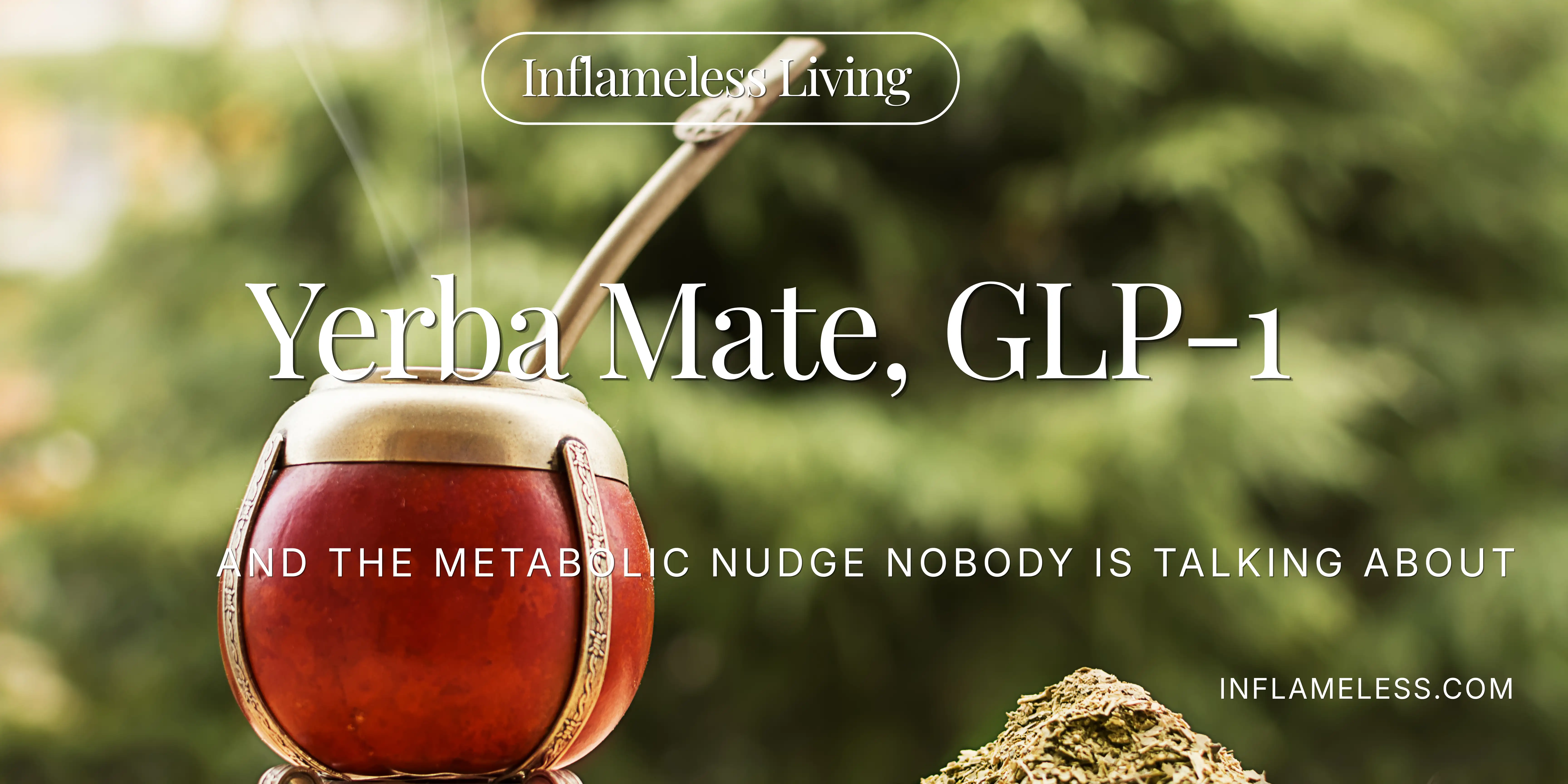
No, it is not “natural Ozempic.” But it may be more interesting than your morning coffee.
Let me guess.
You have heard about Ozempic.
At this point, it is almost impossible not to. It has become the celebrity of the weight loss world, the medication everyone whispers about, argues about, praises, judges, wants, fears or secretly Googles at 11 PM.
And the reason it works is not magic.
It works because it acts on a pathway your body already has: the GLP-1 pathway.
GLP-1 stands for glucagon-like peptide-1, which is a hormone produced in your gut after you eat. One of its jobs is to tell your brain, “We have received food. You can calm down now.”
Very civilized of it.
GLP-1 also helps slow gastric emptying, supports insulin release when blood sugar rises, reduces glucagon and helps regulate appetite. In plain English: it helps your body handle food more smoothly and helps your brain feel less like there is an emergency snack situation every 47 minutes.
So when people say medications like Ozempic “turn off food noise,” part of what they are describing is the amplified effect of this pathway.
But here is where I want us to slow down.
Because the internet has a terrible habit of taking one interesting biological mechanism and turning it into a miracle headline.
And today’s headline could easily become:
“Yerba Mate is natural Ozempic!”
No.
Let’s not do that.
Yerba Mate is not Ozempic. It is not a prescription medication. It does not produce the same pharmacological effect. It is not a replacement for medical treatment, and if you are using medication for diabetes, insulin resistance, weight management or any metabolic condition, this is absolutely something to discuss with your healthcare provider.
But Yerba Mate may still be fascinating.
It´s not a magical pill but it may be a metabolic nudge.
And sometimes, when we are talking about insulin resistance, cravings, inflammation and energy crashes, a well-placed nudge can matter.
First, what is insulin resistance really doing?
Insulin resistance is often explained as a blood sugar problem, but that is only part of the story.
Insulin is the hormone that helps move glucose out of your bloodstream and into your cells, where it can be used for energy. When your cells become less responsive to insulin, glucose has a harder time getting in.
So your body compensates by producing more insulin.
For a while, this may keep your blood sugar looking “normal” on basic labs, which is why many people walk around for years feeling exhausted, snacky, foggy, inflamed and hormonally chaotic before anyone tells them there is a metabolic issue brewing.
This is the part I wish more people understood:
Insulin resistance is not just about sugar.
It is about communication as your cells are not hearing the message properly. So, what does this mean? Well, your pancreas has to speak louder, your blood sugar rises and falls in more dramatic ways and your hunger and cravings are in total chaos.
And when inflammation is part of the picture, the whole system gets even noisier.
This is why “just eat less” is often such useless advice.
If your blood sugar is unstable, your mitochondria are stressed, your sleep is poor, your gut is inflamed and your hunger hormones are disregulated... there is not way you can eat less.
Enter GLP-1: your gut’s “we’re good” signal
GLP-1 is part of a group of hormones called incretins. These hormones are released from the gut after eating and help coordinate what happens next.
Think of GLP-1 as one of the body’s elegant little messengers.
It helps say: “We have eaten.”, “Slow down digestion.”, “Release insulin appropriately.”, “Reduce unnecessary glucose output.”,“Tell the brain we are satisfied.”
This is why GLP-1 has become such a big deal in metabolic medicine.
When that pathway is activated strongly through medication, appetite can drop, gastric emptying slows, blood sugar control can improve and weight loss may follow.
But the important word here is strongly.
Medications like semaglutide are powerful pharmaceutical tools. They are designed to act on GLP-1 receptors in a sustained, potent way.
That can be incredibly helpful for the right person in the right medical context.
It can also come with side effects, especially digestive ones like nausea, vomiting, diarrhea, constipation and abdominal discomfort. And for some people, rapid weight loss can come with other concerns, including loss of lean mass if protein, resistance training and nutrition are not properly supported.
So again, this is not about demonizing medication. It is about properly understanding the pathway.
Because when you understand the pathway, you can also ask a more interesting question:
Are there lifestyle tools that support the body’s own metabolic signaling more gently?
This is where Yerba Mate enters the chat.
So what is Yerba Mate?
Yerba Mate is a traditional South American infusion made from the leaves of the Ilex paraguariensis plant. If you have spent time in Argentina, Uruguay, Paraguay, southern Brazil or with anyone who has, you already know it is not just a drink. Over there, it is a true ritual.
It is bitter, earthy, social, energizing and very much not a vanilla oat latte.
Traditionally, it is prepared in a gourd and sipped through a metal straw called a bombilla. It can also be prepared as tea, iced tea or cold tereré.
Yerba Mate contains caffeine, but it is not just “another caffeinated drink.” It also contains polyphenols, saponins and methylxanthines such as caffeine, theobromine and theophylline.
That combination is part of why many people describe the energy from Yerba Mate as different from coffee.
Coffee can feel like someone kicked open the door of your nervous system, while Yerba Mate, for many people, feels more like someone turned the lights on.
Not always, of course. If you are caffeine-sensitive, anxious, pregnant, breastfeeding, dealing with reflux or struggling with sleep, you still need to be careful. “Natural” does not mean “free pass.”
But metabolically, Yerba Mate is interesting for a few reasons.
The GLP-1 connection
Recent research has started looking at Yerba Mate and incretin signaling, including GLP-1.
Some early studies suggest that compounds in Yerba Mate may influence GLP-1 pathways and post-meal metabolic responses. This is not the same as taking a GLP-1 medication. Not even close.
But it does suggest that Yerba Mate may interact with the gut-metabolic conversation in ways that are worth paying attention to.
And this matters because insulin resistance is not only a “willpower” issue. It is a signaling issue, as I have already mentioned.
Your gut, pancreas, liver, muscles, fat tissue, brain, immune system and mitochondria are all in constant conversation. When that conversation gets distorted by inflammation, poor sleep, ultra-processed food, chronic stress, sedentarism and blood sugar spikes, the body starts making decisions that feel very inconvenient from the outside. What are these? Well, craving sugar, needing caffeine just to feel vaguely alive, feeling hungry soon after eating...
So if a traditional plant infusion can gently support satiety signals, post-meal glucose handling and metabolic flexibility, I am interested. And not because I think it replaces medication, but because I think it belongs in the “small levers that may help” category.
What Yerba Mate may support
The research on Yerba Mate is not perfect or complete yet. We do not have enormous, long-term, perfectly designed human trials proving that it transforms insulin resistance in everyone. Many mechanisms are still being studied.
But the human research we do have suggests Yerba Mate may have favorable effects on certain glycemic markers, including post-meal glucose, HbA1c, and HOMA-IR in some contexts.
That is interesting because for people dealing with insulin resistance, one of the biggest goals is not simply “eat less.” It is to reduce the intensity of glucose and insulin swings so the body can return to a calmer baseline.
Yerba Mate may also support: appetite regulation, energy and alertness, fat oxidation during movement.
So much of metabolic health comes down to repeated daily inputs. The things you do once do not matter nearly as much as the things you do automatically.
If Yerba Mate helps someone replace a sweetened coffee drink, reduce afternoon snacking, feel more focused before a walk or create a ritual that does not involve sugar, that is already useful.
The “nudge, not shove” idea
This is the distinction I want you to remember.
Medication is a shove. Lifestyle is a series of nudges.
Sometimes a shove is necessary because it is life-changing and it is the right tool for that particular moment.
But not every metabolic conversation needs to begin with a shove. A nudge might be enough to get you on the right track like. And yes, an unsweetened Yerba Mate instead of a sweetened drink might be the nudge you need.
Nudges are not headlines but boring magic.
And I am a big fan of boring magic.
But let’s talk about safety
Because this is where wellness culture often skips the important part.
Yerba Mate contains caffeine. That means it can cause side effects in sensitive people, including jitters, anxiety, reflux, palpitations, sleep disruption or digestive discomfort.
If you are pregnant, breastfeeding, have high blood pressure, arrhythmias, anxiety, reflux, insomnia or take medication for blood sugar, blood pressure or stimulants, please do not treat Yerba Mate like a cute harmless herb. Ask your healthcare provider.
Also: do not drink it scalding hot.
Very hot beverages in general can irritate tissues and some research has raised concerns around long-term, high-volume Yerba Mate consumption, especially when combined with smoking or alcohol. Traditional does not automatically mean risk-free.
My practical suggestion?
Use common sense, as we should do with everything in our lvies.
Try it to see what´s like. Do not sweeten it. Do not drink a liter of it like it is a personality trait.
Do not use it at night and then wonder why your brain is writing emails at 1:12 AM.
And if your body says no, listen. Your body is allowed to dislike a trend.
How I would actually use Yerba Mate
If you want to experiment with it, here is the simple version.
Try it in the morning or before a workout.
- Drink it warm.
- Keep it unsweetened.
- Pair it with food if caffeine on an empty stomach makes you feel weird.
- Do not use it as a meal replacement.
- Do not use it to suppress hunger all day.
- Think of it as a supportive ritual, not a punishment tool.
- My favorite metabolic use would be before movement.
The bigger point
The reason I like this conversation is not because Yerba Mate is trendy, but because it reveals something important about metabolic health.
Your cravings, energy crashes, and loud appetite are not signs that your body is broken. They are signals that often come from poor sleep, stress, inflammation, blood sugar swings, gut disruption, low protein or too many ultra-processed foods. Healing is not one supplement, one tea or one diet rule. It is about changing the environment your cells are living in. That is what Inflameless Living is about: less restriction, less obsession and more support so your body can communicate again. Yerba Mate may be one small tool in that process - not a miracle, medication, or shortcut, but a smarter daily ritual that may give your metabolism a gentle nudge.
The takeaway
If you are working on insulin resistance, Yerba Mate may be worth exploring as part of a bigger anti-inflammatory lifestyle.
But please keep the hierarchy clear:
- Protein matters more.
- Fiber matters more.
- Muscle matters more.
- Sleep matters more.
- Stress regulation matters more.
- Meal timing, walking, and reducing ultra-processed foods matter more.
Yerba Mate is a tool. And tools work best when the foundation is already being built.
So if you love coffee, I am not here to confiscate it.
But if you are curious, try Yerba Mate unsweetened in the morning or before movement and notice how your body responds.
This is the kind of nuance we dig into regularly inside the Inflameless Living community - real mechanisms, real food, no hype. If you want to go beyond the headlines and actually understand how to support your metabolic health through daily choices, this is the right place. → Start your 7-day free trial!
References:
Frontiers in Endocrinology. “Yerba Maté and its impact on glycemic control and metabolic health: a systematic review and meta-analysis.” 2025.
Nutrients. “The Incretin Effect of Yerba Maté (Ilex paraguariensis) Is Partially Dependent on Gut-Mediated Metabolism of Ferulic Acid.” 2025.
Mayo Clinic. “Yerba mate: Is it safe to drink?”
NCBI Bookshelf / StatPearls. “Semaglutide.”
Ozempic official prescribing and safety information.
Disclaimer
This article is for educational purposes only and is not medical advice. Yerba Mate is not a replacement for prescription medication, diabetes care, nutrition therapy, or medical treatment. If you have diabetes, insulin resistance, cardiovascular concerns, anxiety, reflux, high blood pressure, sleep issues, are pregnant or breastfeeding, or take medication that affects blood sugar or blood pressure, speak with a qualified healthcare professional before adding Yerba Mate or changing your routine.
If this gave you a new way to think about insulin resistance, cravings, and metabolic health, come join us inside the Inflameless Living Skool group. Substack is where we go deep. Skool is where we turn the ideas into action.