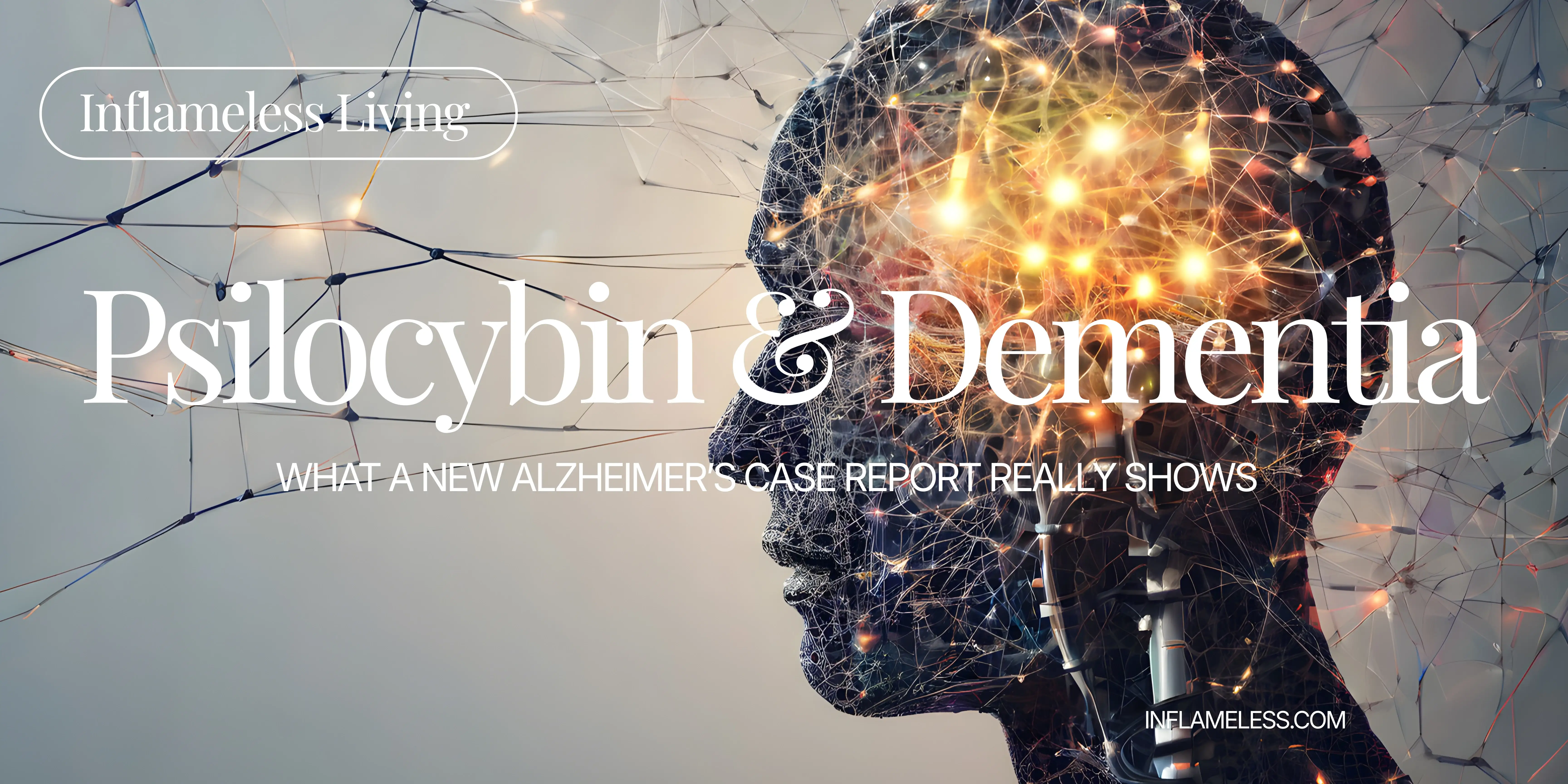
A recent article has been circulating with a headline that sounds almost unbelievable: a compound found in certain mushrooms appeared to reverse dementia symptoms.
The compound in question is psilocybin, the naturally occurring psychedelic substance found in some species of mushrooms, often referred to as “magic mushrooms.” The study behind the headline is fascinating, but it deserves a careful and balanced reading.
The research was not a clinical trial. It was a single case report published in Frontiers in Neuroscience in May 2026. That means the study describes what happened to one person, rather than testing a treatment in a large group of patients under controlled conditions.
Still, the case is important because it raises an intriguing question: in advanced Alzheimer’s disease, are all lost functions truly gone, or can some abilities become temporarily accessible again under certain conditions?
What Is Psilocybin?
Psilocybin is a psychedelic compound found in certain mushrooms. Once inside the body, it is converted into psilocin, which interacts with serotonin receptors in the brain, especially the 5-HT2A receptor.
Because of this action, psilocybin can strongly affect perception, mood, emotional processing, memory, and the way different brain networks communicate. This is why it is being studied in areas such as depression, anxiety, addiction, trauma, and now, very cautiously, neurodegenerative disease.
It is important to understand that psilocybin is not a casual supplement. It can produce intense psychological and physical effects, and its legal status varies by country and region. In medical research, it is typically used in controlled environments with professional supervision.
What Did the Alzheimer’s Case Report Find?
The case report described an elderly woman with approximately 10 years of Alzheimer’s disease and several years of severe functional decline. Before the intervention, she had very limited speech, difficulty walking, urinary incontinence, reduced emotional expression, problems swallowing, and a high level of dependence in daily life.
She received a supervised oral dose of psilocybin-containing mushrooms. According to the report, after the first session she experienced an intense acute phase, including sweating, suspected hyperthermia, profound sleepiness, and a prolonged sleep-like state.
Around 19 hours later, something unexpected happened: she began speaking spontaneously for several hours, including autobiographical memories. In the following days and weeks, caregivers and researchers observed improvements in speech, walking, continence, emotional expression, family recognition, social interaction, and some memory-related responses.
A second supervised session took place one month later with a lower dose. Some of the reported improvements were still present at follow-up, although the authors were careful to describe the changes as temporary and observational.
What Does “Neuron Remodeling” Mean?
One of the most interesting ideas connected to this case is neuron remodeling, which is closely related to the broader concept of neuroplasticity.
Neuroplasticity refers to the brain’s ability to adapt, reorganize, and change the way its cells and networks communicate. Neuron remodeling can include changes in the strength of existing connections, shifts in communication between brain regions, and increased flexibility in certain neural circuits.
A simple way to imagine this is to think of the brain as a city with many roads. In a condition like Alzheimer’s disease, some routes may become damaged, blocked, or less efficient. Remodeling does not mean the entire city is rebuilt overnight, but it may allow traffic to move through alternative routes that were previously underused.
In this case report, the authors suggest that psilocybin may have temporarily changed brain network activity in a way that allowed some remaining abilities to become more accessible. This is a hypothesis, not a proven mechanism, but it is one of the reasons the case has attracted attention.
Why This Finding Is So Interesting
The most compelling part of this report is not the idea of a “cure.” It is the possibility that some functions in advanced dementia may be less permanently lost than we often assume.
Alzheimer’s disease damages the brain, and this damage is real. At the same time, the brain is not a fixed machine. It is a living, responsive system influenced by inflammation, sleep, stress, metabolic health, emotional connection, nutrition, movement, and the chemical environment in which neurons function.
This case suggests that, at least in one person, some abilities may have been temporarily inaccessible rather than completely erased. That is a subtle but powerful distinction.
For those of us interested in inflammation, brain health, and longevity, this points toward a bigger idea: supporting the brain is not only about protecting neurons from damage, but also about supporting the conditions that help neural networks communicate, adapt, and remain flexible for as long as possible.
What This Study Does Not Prove
This case report does not prove that psilocybin reverses Alzheimer’s disease. It does not prove that mushrooms are a dementia treatment, and it should not be interpreted as a protocol to try at home.
There was only one patient, and there was no placebo group or control group. The findings were based on observation rather than standardized cognitive testing or brain imaging. The authors themselves state that the results should be considered preliminary and that the mechanism remains speculative.
The acute effects also matter. The patient experienced symptoms such as sweating, suspected hyperthermia, and profound somnolence. These reactions are a reminder that psilocybin is powerful and may carry significant risks, especially in older adults and people with complex neurological or medical conditions.
The Balanced Takeaway
This case is not a miracle story, but it is a meaningful scientific clue.
It suggests that psilocybin may have the potential to temporarily alter brain network activity in ways that could affect communication, emotional expression, memory retrieval, and functional behavior. Whether this can be done safely, consistently, and meaningfully in people with dementia remains unknown.
For now, the most honest conclusion is this: the study does not show that psilocybin cures dementia, but it does invite researchers to explore whether brain flexibility may still be present even in advanced neurodegenerative disease.
That idea is hopeful, but it must be handled with care.
What This Means for Brain Health
The broader message is that the brain is dynamic. It responds to its internal and external environment every day.
While psilocybin research continues under controlled conditions, we can still focus on the foundations that support brain resilience: reducing chronic inflammation, improving sleep, stabilizing blood sugar, moving regularly, staying socially connected, managing stress and nourishing the brain with anti-inflammatory foods.
The future of dementia research may include unexpected tools, including compounds that influence neuroplasticity. But the foundation of brain health remains the same: create the conditions in which the brain has the best possible chance to communicate, repair and adapt.
The science around neuroinflammation is moving faster than most mainstream health advice can keep up with. Psilocybin research is one thread. The gut-brain axis is another. Mitochondrial function, sleep quality, cortisol rhythm, chronic low-grade inflammation - they all converge on the same question: what can we actually do, today, to protect the brain we are going to need for the next forty years?
That is the conversation happening inside the Inflameless Living communit: practical, evidence-informed protocols built around what the research actually shows, with weekly live calls and a structured lifestyle framework you can apply in real life.
Start with a 7-day free trial now!
References
-
Frontiers in Neuroscience. Transient multidomain functional improvement in advanced Alzheimer’s disease following high-dose psilocybin-containing mushroom administration: a case report. Published May 28, 2026.
https://www.frontiersin.org/journals/neuroscience/articles/10.3389/fnins.2026.1813281/full -
National Institute on Drug Abuse. Psilocybin (Magic Mushrooms).
https://nida.nih.gov/research-topics/psilocybin-magic-mushrooms
Disclaimer
This article is for educational purposes only and is not medical advice. Psilocybin is a powerful psychoactive compound with potential psychological and physical risks, and its legal status varies depending on location. It should not be used to treat Alzheimer’s disease, dementia, or any medical condition outside of appropriate legal, medical, and research settings. Always consult a qualified healthcare professional before making decisions about neurological, psychiatric, or dementia-related care.